
Welcome to Orlando, a city growing faster than a rocket launch from the nearby Space Coast. Beyond the theme park gates and sunny postcard image lies a complex, vibrant metropolis that’s much more than a vacation spot. Is it the right place for you? Making a move is a major decision, and this guide is designed to provide a clear, balanced view of living in Orlando Florida pros and cons. We're cutting through the noise to give you the unfiltered truth you need.
This listicle isn't just another generic overview. We're delivering specific, actionable insights into the realities of daily life here, from the undeniable financial benefit of no state income tax to the tangible frustrations of tourist-heavy traffic. We'll explore the thriving job market, the high cost of housing, the risk of hurricanes, and the abundance of outdoor recreation that defines the Central Florida lifestyle.
To help you make a fully informed decision, we've compiled verified data and local perspectives. All information is presented to adhere to federal fair housing guidelines, ensuring you get an equitable and accurate picture. Let's dig into the details to see if the "City Beautiful" is your perfect match.
1. Pro: Year-Round Warm Climate & Outdoor Lifestyle
One of the most significant advantages of living in Orlando, Florida, is its desirable subtropical climate. With an average annual temperature of 73°F, residents enjoy consistently warm weather and very mild winters, making it a haven for those looking to escape snow shovels and heavy winter coats. This inviting climate is a major factor for many considering a move and is a key benefit when weighing the pros and cons of living in Orlando.
The year-round warmth fosters an incredible outdoor lifestyle. You can spend a January afternoon kayaking on Lake Eola, bike the West Orange Trail in November, or enjoy dinner on a restaurant patio in February. This endless summer atmosphere encourages an active and vibrant community life that doesn't hibernate for half the year. From the beautiful historic neighborhoods of College Park to the lush landscapes in Winter Park, outdoor recreation is always just a few steps away.
Maximizing the Sunshine State Lifestyle
While the weather is a huge plus, navigating the hot, humid summers requires some practical planning. Smart homeowners invest in energy efficiency to manage comfort and costs.
- Time Your Outings: To avoid the peak heat and humidity of summer afternoons, plan your runs, park visits, or yard work for the early morning or later in the evening.
- Dress for the Climate: A wardrobe filled with breathable, lightweight fabrics like cotton, linen, and modern moisture-wicking materials is essential for staying comfortable.
- Prioritize Home Efficiency: When looking at real estate, pay close attention to features like quality insulation, double-paned or energy-efficient windows, and the age of the HVAC system. These elements can significantly impact your summer utility bills.
Local Insight: "A high-quality, energy-efficient A/C system isn't just a luxury here; it's a necessity. We always advise clients to factor the cost of a modern HVAC unit or good home insulation into their budget, as it provides long-term savings and a much more comfortable living experience."
2. Pro: World-Class Theme Parks and Entertainment
Orlando is rightfully known as the theme park capital of the world, a title that profoundly shapes the experience of living here. Residents have unparalleled access to globally renowned attractions like Walt Disney World Resort, Universal Orlando Resort, and SeaWorld. This creates a unique living environment where spontaneous trips to see the fireworks over Cinderella Castle or ride the newest roller coaster are a regular possibility, a major highlight when considering the pros and cons of living in Orlando.

This constant buzz of entertainment means there is always something new to do, especially for families or those who enjoy hosting visitors. Beyond the major parks, the area is filled with water parks, dinner shows, and attractions along International Drive. Many residents, especially those working for the major resorts, enjoy significant perks like free park admission for themselves and guests, making this a truly integrated part of the local lifestyle. This proximity to world-class fun is a distinct advantage that few other cities can offer.
Making the Magic Work for You
Living next to the world's top tourist destinations requires a strategic approach to enjoy the benefits while minimizing the hassles. With a little planning, you can make the theme parks feel like your personal playground.
- Become a Passholder: Florida resident discounts and annual passes are your best friend. Purchase them during promotional periods for the best value and enjoy the freedom to pop into a park for a few hours.
- Learn the Back Roads: Navigating Orlando like a local means knowing how to avoid tourist-heavy corridors like I-4. Learning alternate routes through areas like Lake Buena Vista and Dr. Phillips can save you significant time.
- Strategic Housing Choices: If you crave proximity without the constant tourist traffic, consider suburbs like Winter Garden, Windermere, or Horizon West. These communities offer great access to the parks while providing a more residential feel.
Local Insight: "We often guide clients to neighborhoods that offer a perfect balance. You can live in a quiet, family-friendly community and still be just a 15-minute drive from the theme parks. It's about finding that sweet spot where you can easily access the entertainment without living in the middle of it."
3. Pro: No State Income Tax
A significant financial advantage of living in Orlando is that Florida has no state income tax. As one of only a handful of states without this tax, residents can keep a larger portion of their earnings, which is a powerful incentive for professionals, families, and retirees alike. This financial benefit is a crucial point to consider when evaluating the pros and cons of living in Orlando, as the savings can be substantial over time.
This tax-friendly environment means more disposable income for everything from buying a home to investing for the future. For example, a professional earning a $75,000 salary could see an extra $3,000 to $5,000 in their annual take-home pay compared to living in a state with moderate income taxes. This advantage is especially pronounced for high-earning individuals and retirees who no longer have to pay state taxes on their retirement income, pensions, or Social Security benefits.
Leveraging Florida's Tax Advantage
While the absence of a state income tax is a major draw, it's important to understand the complete financial picture. Smart financial planning involves looking at all aspects of the local tax structure to truly benefit.
- Understand the Full Tax Picture: Balance the lack of state income tax against other taxes. Florida has a state sales tax (plus local options) and relies heavily on property taxes to fund public services. Factor these into your overall budget.
- Establish Residency Correctly: To legally benefit from Florida’s tax laws, you must properly establish residency. This involves obtaining a Florida driver's license, registering to vote, and filing a "Declaration of Domicile" with your county clerk's office.
- Consult a Professional: If you have complex financial situations, such as owning property in another state or earning income from multiple sources, consult a tax advisor to ensure you are complying with all regulations and maximizing your savings.
Local Insight: "We often see clients from states like California and New York who are stunned by how much their purchasing power increases here. The money saved on state income tax can be the difference between buying their ideal home or affording key upgrades. It directly translates into a better quality of life."
4. Con: Hurricane and Severe Weather Risk
A significant factor to consider when evaluating the pros and cons of living in Orlando, Florida, is the seasonal risk of severe weather. Located in Central Florida, the region is susceptible to tropical storms and hurricanes during the Atlantic hurricane season, which runs from June 1st to November 30th. While Orlando's inland position protects it from the coastal storm surge that affects cities like Miami or Tampa, strong winds, heavy rainfall, and the potential for widespread power outages are serious realities residents must prepare for.
Recent history highlights the importance of this consideration. Hurricane Ian in 2022 brought unprecedented flooding to some areas and caused significant property damage and power disruptions across the metro. Similarly, Hurricane Irma in 2017 and Hurricane Charley in 2004 served as stark reminders of how quickly storms can impact daily life, even far from the coast. This potential for disruption is a crucial aspect of the Orlando lifestyle that requires proactive planning.
Preparing for Storm Season
Preparedness is the key to safely navigating hurricane season in Central Florida. By taking steps ahead of time, residents can significantly reduce stress and mitigate potential damage.
- Build Your Kit: Assemble a hurricane preparedness kit well before a storm is on the horizon. Include non-perishable food, at least one gallon of water per person per day, flashlights, batteries, a first-aid kit, and a battery-powered radio.
- Secure Your Property: When looking at homes, consider properties with existing storm protection. Investing in impact-resistant windows or hurricane shutters is a common and wise upgrade that adds both safety and value.
- Know Your Insurance: Thoroughly review your homeowner's insurance policy to understand your coverage for wind damage and flooding. Standard policies often do not cover flood damage, which may require a separate policy.
- Have a Plan: Develop a family communication and evacuation plan. Know your evacuation zone (even inland areas have them) and identify nearby shelters in case you need to leave your home.
Local Insight: "We always advise our clients to make hurricane preparedness a year-round mindset. Understanding your insurance deductibles and having a reliable generator or portable power source can make a world of difference. Being prepared turns a potential crisis into a manageable event."
5. Con: Heavy Tourist Traffic and Congestion
A significant downside when considering the pros and cons of living in Orlando, Florida, is the immense volume of tourism. As the "Theme Park Capital of the World," the city welcomes tens of millions of visitors annually. This constant influx places a considerable strain on local infrastructure, leading to persistent traffic congestion and crowded public spaces that can impact the daily lives of residents.
The tourism effect is most noticeable on the roads and in popular areas. Major arteries like Interstate 4 can become notoriously gridlocked, especially during rush hour or peak tourist seasons, turning a simple commute into a lengthy ordeal. Similarly, finding a table at a popular restaurant or enjoying a quiet evening in the downtown area often requires significant advance planning to navigate the crowds. This is a crucial factor for potential homebuyers to consider.
To give you a clearer picture of the scale, here are a few key data points summarizing the situation.
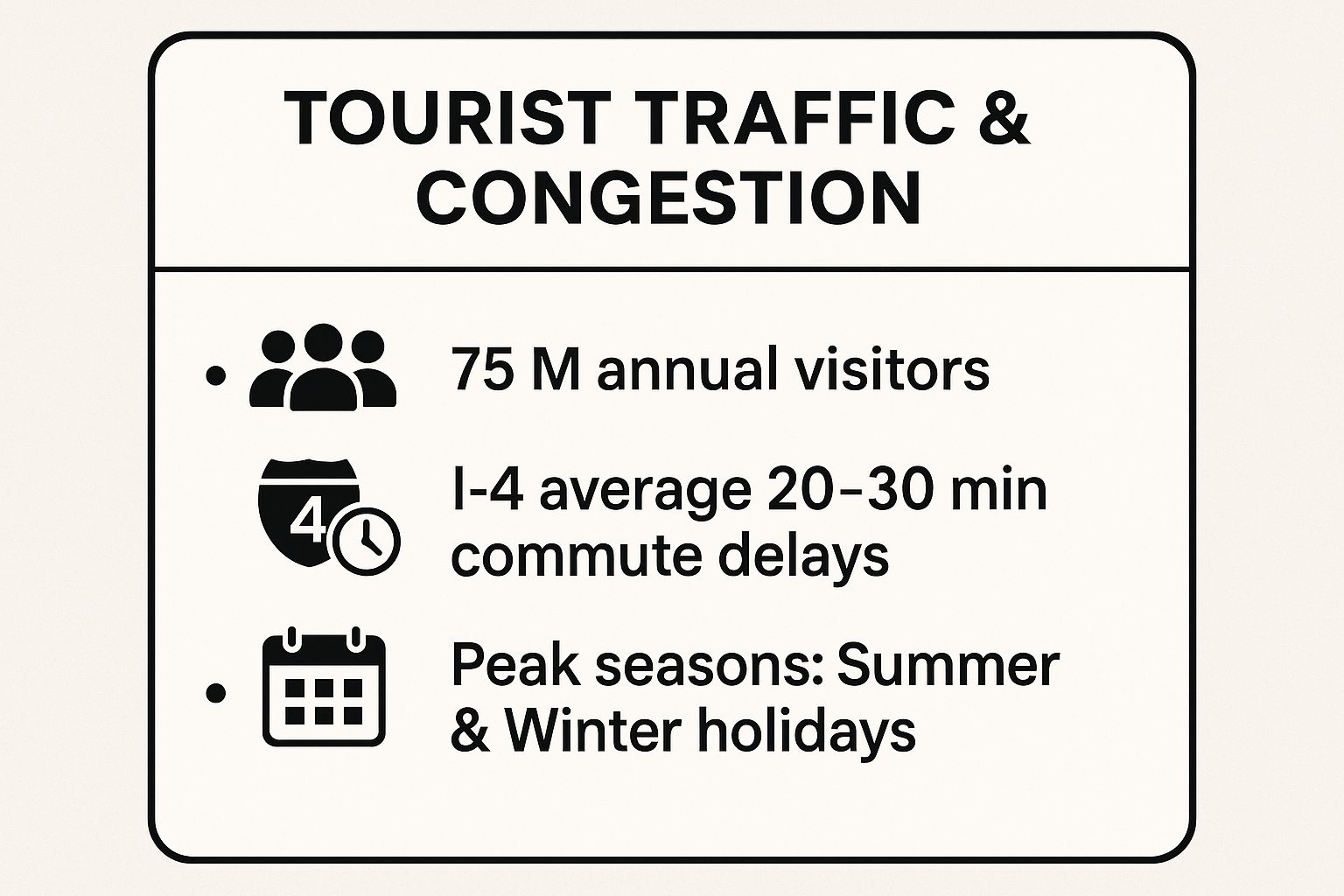
These figures highlight how the tourism industry directly translates into daily delays and seasonal surges that residents must learn to manage.
Navigating the Tourist Tides
While the congestion is a real challenge, locals develop strategies to minimize its impact on their lifestyle. Smart planning and a bit of local knowledge can make a world of difference.
- Master Alternate Routes: Rely on navigation apps like Waze or Google Maps to find detours around major pile-ups on I-4. Learning the local surface streets can save you significant time.
- Plan Ahead for Dining: For popular restaurants, especially in areas like Dr. Phillips or near Disney Springs, making reservations well in advance is not just recommended, it's essential.
- Live Strategically: Choosing a neighborhood outside the primary tourist corridor can drastically improve your quality of life. Suburbs like Winter Park, Lake Nona, or Maitland offer a more residential feel with less tourist traffic.
- Embrace the Off-Peak: Schedule errands, appointments, and even trips to local attractions during weekday mornings or the "shoulder seasons" (fall and spring) when crowds are thinner.
Local Insight: "We always encourage clients to think about their daily commute. Living in a neighborhood like College Park or Thornton Park gives you a fantastic urban lifestyle while keeping you slightly insulated from the tourist-heavy zones of I-Drive and Lake Buena Vista. It's about finding that perfect balance."
6. Con: High Cost of Living and Housing
A significant downside to Orlando's growing popularity is a cost of living that has risen sharply, now sitting above the national average. This surge is fueled by rapid population growth and intense demand in the housing sector. While new residents from high-cost states might find Orlando comparatively affordable, many long-term locals and middle-income earners face a challenging financial landscape.
Housing costs are the primary driver of this expense, with median home prices and rental rates increasing dramatically. The competitive market can make it difficult to afford homes near work, often forcing people into long commutes. The conversion of long-term rentals into short-term vacation properties has further tightened the housing supply, impacting affordability for many considering the pros and cons of living in Orlando.
Navigating Orlando's Housing Market
To manage the high costs, prospective residents must be strategic and explore all available options to find a home that fits their budget without sacrificing quality of life.
- Explore Emerging Neighborhoods: Look beyond the city center to areas like Lake Nona, Clermont, or Sanford. These communities often provide better value and more space, though it's crucial to factor in potential commute costs.
- Consider All Housing Types: Single-family homes are not the only option. Condos and townhomes can be a more affordable entry point into the market, often with lower maintenance responsibilities.
- Budget for All Expenses: When purchasing a home, look past the sale price. Factor in potential HOA fees, property taxes, and the cost of necessary renovations. Understanding expenses like shower remodel costs is crucial for creating an accurate long-term budget.
- Research Assistance Programs: Orange County and other local municipalities offer first-time homebuyer programs and down payment assistance. These can be invaluable resources for making homeownership more attainable.
Local Insight: "The Orlando market is competitive, but opportunities still exist. We encourage buyers to get pre-approved for a mortgage early and be ready to act fast. Exploring a variety of neighborhoods and housing types is key to finding a property that aligns with your financial goals in the current climate."
7. Pro: Diverse Job Market and Economic Growth
While synonymous with tourism, Orlando has cultivated a robust and surprisingly diverse economic landscape that extends far beyond the theme park gates. This evolution into a major hub for technology, healthcare, aerospace, and education is a significant pro for anyone considering a move, offering a wealth of career opportunities that contribute to the city's dynamic growth and stability. This diverse job market is a key factor when evaluating the pros and cons of living in Orlando.
Major corporations like Electronic Arts, Siemens, and Verizon have established significant operations here, solidifying the city's business-friendly reputation. Furthermore, the Medical City at Lake Nona is a powerhouse of innovation, hosting world-class institutions like Nemours Children's Hospital and the UCF College of Medicine. Even the city's famous tourism sector creates a ripple effect of employment; for a deeper look, an Orlando's vacation rental market analysis reveals how this industry fuels jobs in hospitality, management, and real estate.
Tapping Into Orlando's Career Opportunities
Navigating this expanding job market requires a strategic approach. Professionals can leverage the city's growth by connecting with key industries and organizations.
- Network Strategically: Engage with professional groups like the Orlando Tech Association or Young Professionals of Orlando to build connections within high-growth sectors.
- Upskill and Educate: Consider continuing education programs at the University of Central Florida (UCF) to align your skills with in-demand fields like medical technology or simulation.
- Leverage Your Experience: Skills gained in the tourism industry, such as high-level customer service and event management, are highly transferable to corporate roles in other sectors.
- Explore Niche Sectors: Investigate opportunities within the Lake Nona Life Sciences cluster or the region's burgeoning aerospace and defense simulation industry.
Local Insight: "We see professionals moving here not just for the lifestyle, but for the career trajectory. The growth in Lake Nona's Medical City, for example, has created a boom in real estate demand from doctors, researchers, and tech professionals. It proves Orlando’s economy is much more than just tourism."
8. Abundant Recreation and Outdoor Activities
Beyond the theme parks, one of the most compelling pros when considering living in Orlando, Florida, is the sheer abundance of outdoor recreation. Central Florida’s unique geography places you in the heart of a natural playground, with pristine springs, sprawling lakes, lush state parks, and miles of trails. The year-round warm climate means these activities aren't just seasonal hobbies but a consistent part of the lifestyle.

Residents can spend a winter morning watching manatees gather at Blue Spring State Park, an afternoon bass fishing on the renowned Butler Chain of Lakes, or a weekend biking the West Orange Trail, which connects charming communities like Winter Garden. This incredible access to nature provides a perfect counterbalance to the city's urban energy and is a key factor in the high quality of life many residents enjoy. Plus, both the Atlantic and Gulf Coast beaches are just a short drive away for a quick seaside escape.
Making the Most of Orlando's Outdoors
To fully enjoy the natural beauty Central Florida offers, a little local knowledge and preparation go a long way. This ensures your outdoor adventures are safe, comfortable, and frequent.
- Plan Around the Heat: During the hot summer months, schedule your hikes, kayaking trips, or bike rides for the early morning or late afternoon to avoid the most intense sun and humidity.
- Stay Safe Around Water: Freshwater is a hallmark of Florida, but it's crucial to always be aware of your surroundings. Heed all posted alligator and wildlife warnings at lakes, springs, and rivers.
- Invest in Gear: Quality sun protection, including hats, sunscreen, and UPF clothing, is non-negotiable. Reusable water bottles and hydration packs are also essential for staying hydrated in the Florida heat.
- Get a Park Pass: If you plan on being a frequent visitor, an annual pass to Florida State Parks is a cost-effective way to explore dozens of unique natural areas.
Local Insight: "We often hear from clients, especially those relocating, how surprised they are by the diversity of outdoor activities. It's not just beaches. We have clients who are avid bird watchers, cyclists, and boaters. Proximity to places like the West Orange Trail or the Lake Nona trail system can be a major selling point for a home."
Orlando Living: 8-Point Pros & Cons Comparison
| Item | Implementation Complexity 🔄 | Resource Requirements ⚡ | Expected Outcomes 📊 | Ideal Use Cases 💡 | Key Advantages ⭐ |
|---|---|---|---|---|---|
| Year-Round Warm Climate | Low — natural climate, minimal effort | Moderate — need for cooling and insulation | Comfortable outdoor lifestyle most of the year | Outdoor recreation, gardening, year-round living | Consistent warmth, reduced heating costs |
| World-Class Theme Parks & Entertainment | High — requires extensive infrastructure | High — large staff and maintenance needs | Unique entertainment access and job market | Families, tourism workers, entertainment seekers | Global attractions, resident discounts |
| No State Income Tax | None — tax policy | Low — no income tax filings required | Higher take-home pay, tax savings | Professionals, retirees, high earners | Significant tax savings, business-friendly |
| Hurricane and Severe Weather Risk | Moderate — building codes and prep plans | High — emergency supplies and insurance | Risk mitigation with potential property damage | Residents in hurricane-prone areas | Inland location reduces surge risk, strong codes |
| Heavy Tourist Traffic and Congestion | Moderate to high — traffic management needed | High — infrastructure and navigation tools | Increased commute times and crowded areas | Residents near tourist zones, service industries | Tourism drives economy, job availability |
| High Cost of Living and Housing | Low — market driven | High — significant housing and living costs | Limited affordable housing, market appreciation | Homebuyers, renters, investors | Real estate appreciation, luxury amenities |
| Diverse Job Market and Economic Growth | Moderate — diversified economy | Moderate — variety of industries supports | Broad career opportunities beyond tourism | Job seekers in tech, healthcare, aerospace | Competitive salaries, strong business growth |
| Abundant Recreation and Outdoor Activities | Low — natural resources | Low to moderate — park maintenance and gear | High outdoor activity engagement | Outdoor enthusiasts, families, health-conscious | Year-round recreation, proximity to beaches |
Making Your Orlando Move: Is It the Right Choice for You?
The decision to call Orlando home is a deeply personal one, a careful balancing act between vibrant opportunities and practical challenges. As we've explored, the city presents a compelling duality. On one side, you have the undeniable allure of a sun-drenched lifestyle, a booming and diverse job market, and zero state income tax, leaving more of your hard-earned money in your pocket. The proximity to world-class theme parks and an endless calendar of events offers a life rich with excitement and recreation.
On the other side, the realities of living in Orlando, Florida, include navigating a high cost of living, particularly in the competitive housing market, and contending with the infamous tourist traffic. The year-round warmth also brings intense summer heat and the ever-present risk of hurricanes, which requires serious preparation and consideration. The pros and cons of living here are not just bullet points on a list; they are daily factors that will shape your experience in "The City Beautiful."
Weighing the Scales for Your Lifestyle
Ultimately, whether Orlando is the right fit for you depends on what you prioritize. The key is to find a personal equilibrium where the benefits align with your goals and the drawbacks are manageable for your circumstances.
- For the Career-Focused Professional: A growing tech or healthcare salary might make the higher housing costs in desirable neighborhoods like Winter Park or College Park a worthwhile investment. The economic growth here presents a tangible path for career advancement that can offset other expenses.
- For the Family-Oriented Household: The abundance of family-friendly activities is unparalleled. The trade-off might be choosing a home in a suburb further from the central tourist hubs to gain more space and a quieter community, strategically mitigating the daily traffic woes.
- For the Outdoor Enthusiast: If your weekends are spent on the water or exploring nature trails, the access to lakes, springs, and parks is a massive pro. Your focus might be on finding a property that offers easy access to these natural amenities, making the urban congestion a minor inconvenience.
Before you start packing, it's crucial to do your homework. A research visit during different seasons, perhaps once in the peak heat of August and again in the milder winter, can provide invaluable insight. For those relocating from further away, proper planning is essential. If you're making the leap to Orlando from another state, our essential moving out of state checklist guide can prove invaluable for a smooth transition. By understanding the intricate dance of living in Orlando, Florida, pros and cons, you empower yourself to make a confident and informed decision, ensuring your move is not just a change of address, but a true step toward the life you envision.
Ready to explore how your dream home fits into the Orlando landscape? Connect with a local real estate professional who has the deep-rooted knowledge to guide you through every neighborhood, from historic homes to modern marvels. They can help you find a property that perfectly balances your lifestyle needs with the unique opportunities of Central Florida.
Article created using Outrank
