
Navigating the home buying process without a roadmap can be a recipe for stress and costly mistakes. Think of a comprehensive home buying checklist template as your personal guide—an indispensable tool that takes you from daydreaming about houses all the way to holding the keys on closing day.
It's about more than just checking off boxes. A solid checklist keeps you organized, helps you sidestep expensive errors, and ultimately, puts you in control of one of the most significant financial decisions you'll ever make.
Your Command Center For Buying A Home
Jumping into the home buying process without a clear plan feels like trying to assemble a complex piece of furniture without the instructions. It's frustrating, inefficient, and you're almost guaranteed to make a mistake. A well-structured checklist is your command center, transforming what can feel like a chaotic process into a calm, manageable mission.
This isn't just about a generic to-do list. It's about crafting a personalized strategy that aligns with your financial reality and life goals. A great template prompts you to tackle the big milestones in a logical order, making sure no crucial step gets missed along the way.
Key Stages Of Your Home Buying Mission
A proper checklist guides you through several distinct phases of the journey. It all starts long before you even think about looking at a single listing, focusing first on building a solid financial foundation. This means getting a clear picture of your budget, reviewing your credit, and—most importantly—securing a mortgage pre-approval.
Once your finances are in order, the active search begins. Your checklist will help you define what you truly need in a home, research different communities, and compare properties with a clear head. This methodical approach is invaluable. When you finally find "the one," the list becomes your lifeline for managing the offer, the negotiations, and that intense period between signing the contract and getting to the closing table.
For those looking for an all-in-one solution, many builders and real estate professionals offer a complete home buyers package that bundles resources to simplify the entire process.
To give you a clearer picture, here’s a high-level look at the major stages you'll work through.
Home Buying Checklist Key Stages
| Phase | Primary Goal | Key Actions |
|---|---|---|
| Financial Prep | Get mortgage-ready and define your budget. | Check credit, calculate DTI, save for down payment, get pre-approved. |
| The Search | Find the right home in the right location. | Define must-haves, research communities, attend open houses. |
| Offer & Negotiation | Secure the property at the best possible terms. | Make an offer, negotiate price and contingencies, sign purchase agreement. |
| Due Diligence | Ensure the home is a sound investment. | Schedule home inspection, appraisal, and review disclosures. |
| Closing | Finalize the purchase and take ownership. | Secure homeowners insurance, do a final walk-through, sign closing docs. |
Each of these phases has its own set of critical tasks, and having them laid out in front of you removes the guesswork and stress.
A detailed checklist does more than just organize tasks; it empowers you with knowledge and confidence. When you know what comes next—from the home inspection to the final walk-through—you can anticipate challenges and make smarter, more decisive choices.
Visualizing Your Path To Homeownership
Getting your finances organized is ground zero. It’s the launchpad for your entire home buying adventure. The image below perfectly captures the essence of this initial "command center" stage—where your budget, your calculations, and your plan all come together.
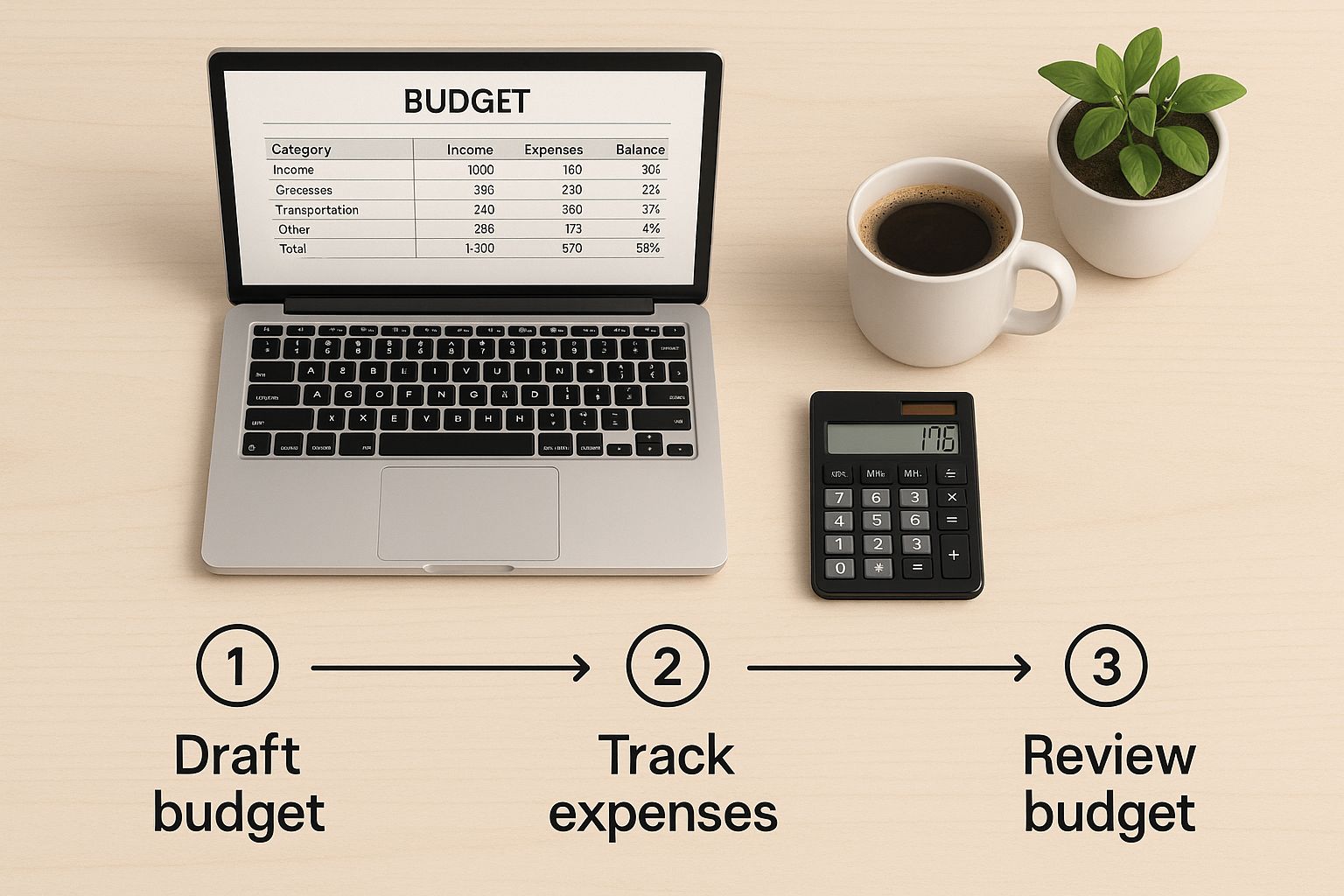
This image really drives home the point that a successful purchase doesn't start with open houses. It starts with clarity and organization right at your own desk. The real goal is to adapt any template into a living, breathing tool that fits your unique situation. Whether you're a first-time buyer or a seasoned investor, a personalized checklist is your secret weapon for staying on track, on budget, and one step ahead of the game.
Building a Solid Financial Foundation
Before you even think about scrolling through listings or visiting open houses, the most important work of your home-buying journey happens right at your desk, with your finances. This is the moment your home buying checklist template becomes more than a to-do list—it turns into your financial command center. Getting this groundwork right determines your budget, how much a lender will trust you with, and ultimately, the kind of home you can confidently and comfortably afford.
First things first: you need a brutally honest picture of what you can truly afford. This number is so much more than the mortgage payment you see on a calculator. You have to think like a homeowner and account for the full spectrum of costs, often called PITI.
- Principal: The part of your payment that actually chips away at your loan balance.
- Interest: What the lender charges you for the privilege of borrowing their money.
- Taxes: Property taxes, which can be a significant cost depending on your city and county.
- Insurance: Homeowners insurance is non-negotiable; it protects your massive investment.
And don’t forget potential Homeowners Association (HOA) fees. These can easily add a few hundred dollars to your monthly housing costs. If you ignore these costs, you're working with a fantasy budget, not a realistic one.
Your Credit Score and Debt-to-Income Ratio
Your credit score is a key factor in the mortgage world. It’s one of the first things a lender will scrutinize, and a higher score often means a lower interest rate. That difference can save you tens of thousands—or even hundreds of thousands—of dollars over the life of your loan. Lenders typically see a score of 740 or higher as the gold standard for snagging the best rates.
Just as critical is your debt-to-income (DTI) ratio. It’s a simple percentage that shows how much of your gross monthly income goes toward paying off existing debts (think car payments, student loans, credit card balances). Most lenders want to see a DTI of 43% or less.
Let’s look at a real-world scenario. Say two buyers earn the exact same salary. Buyer A has a 750 credit score and a 30% DTI. Buyer B has a 650 score and a 42% DTI. Buyer A is very likely to qualify for a larger loan at a much better rate, giving them more buying power. Why? They managed their credit and debt more effectively before they ever started looking.
Saving for Your Down Payment and Closing Costs
Putting together a solid down payment is a cornerstone of financial readiness. While the classic 20% down payment is famous for helping you dodge Private Mortgage Insurance (PMI), don't panic if that feels out of reach. Many loan programs are much more flexible. An FHA loan, for example, might only require 3.5% down.
Just remember, the down payment isn't the only pile of cash you'll need at the finish line. Closing costs, which cover all the administrative and legal fees like appraisals and title searches, typically run between 2% and 5% of the home's final sale price.
A healthy emergency fund is also a must-have. Owning a home means things will break, and you need to be ready. Learning how to build an emergency fund gives you a crucial safety net for when the water heater inevitably gives out on a holiday weekend.
Understanding Mortgage Options
The mortgage world can feel like alphabet soup, but you just need to know the basics. Your checklist should have space to compare the heavy hitters:
- Conventional Loans: These aren't backed by the government. They often require a stronger credit score and a bigger down payment, but the terms can be more favorable if you qualify.
- FHA Loans: Insured by the Federal Housing Administration, these are a lifeline for many first-time buyers who have lower credit scores or smaller down payments.
- VA Loans: A fantastic benefit for eligible veterans, active-duty service members, and their spouses. They often require no down payment and have no PMI.
- USDA Loans: Designed for buyers in specific rural and suburban areas, these also may not require a down payment.
A huge part of this process is understanding the market you're walking into. For instance, in the U.S. housing market, new home prices saw a notable increase of about 20% between early 2020 and late 2023. That kind of market movement makes affordability a massive hurdle and changes the math for everyone.
Getting pre-approved for a mortgage is the final, powerful step in this financial boot camp. A pre-approval letter isn't just a piece of paper; it's proof to sellers that you're a serious, qualified buyer. In a competitive market, it's what lets you act fast when you find the one. It solidifies your budget and turns you from a "looker" into a "buyer."
Navigating Your Home Search and Offer

Alright, you’ve got your finances sorted and a pre-approval letter in your back pocket. Now the real adventure begins. This is the moment your home buying checklist template transforms from a financial planner into your boots-on-the-ground playbook for snagging that perfect home.
The hunt is about more than just swooning over trendy kitchens or huge backyards. It’s about keeping a level head and making a smart, objective decision, especially when your emotions are running high.
Your first move? Get brutally honest about what you absolutely need versus what would just be nice to have. This simple distinction is what stops you from falling for a house with an amazing pool but a commute that will slowly drain your quality of life.
Defining Your Must-Haves and Nice-to-Haves
Think of your checklist as the ultimate filter for your future home. Before you even think about stepping into an open house, you have to separate your deal-breakers from your daydreams. This is how you avoid the classic trap of falling in love with a property that just doesn’t fit your life.
Your "must-haves" are the absolute non-negotiables. These are the core features a home has to have for you to even consider it.
- Minimum number of bedrooms and bathrooms: Be honest about your needs for today and the near future.
- Location and commute time: Don't underestimate how much a long drive can impact your quality of life.
- Specific home features: This could be a fenced-in yard for pet owners or a first-floor primary bedroom.
Then you have your "nice-to-haves"—the bonus features. These are the perks you'd love but could live without if everything else is perfect. Maybe it’s a dedicated home office, a two-car garage, or being able to walk to your favorite coffee spot. Getting these down on paper lets you score each property objectively, rather than trying to rely on a fuzzy memory later.
Researching Neighborhoods and Touring Homes
Once you know what you’re looking for, it’s time to nail down where. Your checklist should have a section dedicated to each community you're exploring. Don't just scroll through listing photos; get out there and investigate the area.
Drive through at different times of the day and week—a weekday morning commute is a world away from a Saturday night. Are the streets peaceful? Is traffic a nightmare?
When it’s time for home tours, your checklist becomes your secret weapon. It forces you to look beyond the fresh paint and perfectly staged furniture and zero in on what truly matters.
It's so easy to get wowed by surface-level updates during a tour. Your checklist keeps you grounded. It reminds you to ask about the age of the HVAC system, peek under sinks for signs of water damage, and check the condition of the windows. These are the big-ticket items that a seller’s fresh coat of paint might be trying to hide.
For every single home you visit, start a new page on your template. Snap photos and attach them directly to your notes. After a few weeks and a half-dozen houses, they all start to blur together. You won't remember which one had the updated bathroom and which had that weird, choppy layout. Your detailed notes will be your saving grace for making a clear-headed comparison.
Making a Competitive Offer
You found it. "The One." Now it's time to make your move. In a competitive market, a strong offer is about much more than just the price tag. Your agent is your guide here, but your checklist helps you come to the table prepared.
Key Offer Components:
- Offer Price: This should be based on comparable sales (or "comps") that your agent pulls for the area.
- Earnest Money Deposit: This shows you’re a serious buyer. It’s typically 1-3% of the sale price.
- Contingencies: Think of these as your safety net. They're clauses that let you back out of the deal without losing your deposit if certain things don’t pan out. The most common are a satisfactory home inspection, the home appraising for at least the offer price, and your final mortgage approval coming through.
- Closing Date: This is the proposed date to finalize the sale, usually 30-45 days from when the offer is accepted.
A well-crafted offer, backed by that strong pre-approval and a clear grasp of your terms, puts you in a powerful position. This whole structured process, guided by your checklist from the very start, is what lets you move with confidence and purpose, turning a stressful process into a successful mission.
An accepted offer is a huge win, but don’t pop the champagne just yet. This next phase is the final, crucial leg of the race, and your home buying checklist template is what will get you across the finish line to the closing table.
This is the due diligence period—the critical window where you confirm that the house you’ve fallen for is actually a sound investment. It’s a whirlwind of inspections, appraisals, and a mountain of paperwork. Staying organized right now is what prevents last-minute chaos and ensures you aren't hit with any nasty surprises when you get the keys.
Navigating the Home Inspection
This is probably the single most important step after your offer is accepted. A home inspection is your chance to get a professional, unbiased look at the property’s real condition, way beyond the pretty stuff you noticed on the tour. Think of it as your primary defense against hidden, costly problems.
The inspector will meticulously crawl through the home's core systems and structure. Afterwards, you'll get a detailed report, often dozens of pages long, packed with photos and notes. Don’t panic when you see it; no home is perfect, not even a brand-new build. Your job is to zero in on the big-ticket items.
Pay close attention to these areas:
- Structural Issues: Any problems with the foundation, roof, or major structural components.
- Major Systems: The age and condition of the HVAC, plumbing, and electrical systems.
- Water Intrusion: Signs of past or present leaks, mold, or water damage are massive red flags.
- Safety Hazards: Things like faulty wiring, missing GFCI outlets in wet areas, or unsafe stairs.
When the inspection report comes back, it's easy to get overwhelmed. A good real estate agent is worth their weight in gold here; they'll help you separate the "must-fix" items from the minor "good-to-know" issues. A leaky roof demands immediate attention; a sticky doorknob does not.
If the inspection uncovers significant problems, you have options. Your checklist should prompt you to decide on a path forward. You can ask the seller to make the repairs, request a credit at closing to handle the fixes yourself, or, if the issues are just too severe, you can walk away from the deal (as long as your contract includes an inspection contingency).
The Appraisal and Final Mortgage Approval
While you’re laser-focused on the physical condition of the house, your lender is focused on its value. They’ll order an appraisal to make sure the property is worth at least what you’ve agreed to pay. It’s how the bank protects its investment. A licensed appraiser will evaluate the home and compare it to recent sales of similar properties in the area.
Most of the time, the appraisal comes in at or above the purchase price, and everything moves ahead smoothly. But what if it comes in low? You have a few choices:
- Renegotiate: Go back to the seller and ask them to lower the price to the appraised value.
- Pay the Difference: If you have the cash, you can cover the gap between the appraised value and the sale price yourself.
- Challenge the Appraisal: This is a long shot, but you can sometimes submit additional comps to the appraiser to make your case.
- Walk Away: Your financing contingency should allow you to cancel the contract if the home doesn't appraise.
During this time, your lender's underwriting team will also be doing a final deep dive into your finances. They'll likely re-verify your employment and check for any new debt you’ve taken on. The golden rule: Don't make any major purchases or changes to your finances—like buying a car or changing jobs—until after you close. Seriously.
Final Steps Before the Closing Table
The last couple of weeks are all about tying up loose ends. Your checklist should include these final, critical tasks to guarantee a smooth closing day.
- Secure Homeowners Insurance: Your lender will require you to have a policy in place before they fund the loan. Start shopping around for quotes early to get the best rate.
- Transfer Utilities: Get on the phone and schedule the transfer of electricity, water, gas, and internet service into your name, effective on your closing date. You don't want to move in in the dark!
- Final Walk-Through: This usually happens 24 hours before closing. It’s your last chance to make sure the home is in the same condition as when you agreed to buy it and that any negotiated repairs were actually completed properly.
This journey from an accepted offer to finally holding the keys can feel intense. But a well-managed checklist keeps you in the driver's seat. It makes sure every "i" is dotted and every "t" is crossed, so the only thing you have to worry about on closing day is where you're going to hang the first picture.
How to Customize Your Checklist
A standard home buying checklist template is a fantastic place to start, but its real magic is unlocked when you make it your own. No two home-buying experiences are ever the same. Your journey will have its own unique priorities, unexpected property quirks, and personal hurdles to clear.
Think of it as the difference between a one-size-fits-all t-shirt and a tailored suit. Both get the job done, but only one is a perfect fit. By turning a generic template into your personal action plan, you're not just checking boxes—you're preparing for your specific home-buying scenario.
Tailoring for the First-Time Homebuyer
Buying your first place is a significant life event. It's incredibly exciting, but the learning curve can feel almost vertical. It's a world filled with new rules and potential surprise costs, and your checklist needs to be your most patient, detail-obsessed guide.
First-timers face some pretty specific challenges, especially today. You’re trying to save for a down payment and build a solid credit score while navigating high home prices and competition. In fact, a significant number of first-time buyers ends up spending more than they planned, which just goes to show how critical it is to have a rock-solid financial game plan. You can see what other first-time buyers are facing to get a sense of the landscape.
Your custom checklist should have extra steps built right in for financial education and special programs.
- Hunt for First-Time Buyer Programs: Add a task to actively research state and local down payment assistance, grants, and mortgages designed for people like you.
- Itemize "Hidden" Costs: Don't just budget for the down payment. Create a dedicated sub-list for things like appraisal fees, title insurance, initial escrow deposits, and even moving expenses.
- Interview at Least Three Agents: Your first agent is your most important partner. Make it a non-negotiable checklist item to chat with a few agents who really specialize in helping first-time buyers.
A first-timer's best defense is diligence. Your checklist should be a constant reminder to ask more questions—of your lender, your agent, and yourself. Add prompts like "Confirm I understand the Closing Disclosure" or "Double-check the property tax estimates" to make sure you know exactly what you're signing.
Adapting for Unique Property Types
Not all homes are the same. If you're looking at a condo, brand-new construction, or a historic home, your checklist needs to evolve. Each of these property types has its own set of rules, regulations, and required inspections.
Take a condo, for example. You're not just buying a unit; you're joining a community with a Homeowners Association (HOA) that has its own governing documents. Your standard checklist won't cut it.
Checklist Add-Ons for a Condo:
- Deep-Dive into HOA Docs: This isn't a quick skim. You need to read the bylaws, covenants, and, most importantly, the financial statements. Look for red flags like pending lawsuits or big special assessments on the horizon.
- Verify HOA Fees (and What's Included): What exactly are you paying for? Trash? Water? Exterior maintenance? This is critical for figuring out your true monthly housing cost.
- Check the Health of the Reserve Fund: A skimpy reserve fund is a huge red flag. It means you could get slapped with a massive bill when the building needs a new roof or elevator.
Likewise, new construction requires a completely different type of scrutiny.
Checklist Items for New Construction:
- Investigate the Builder's Reputation: Get online and read reviews. Talk to people who live in their other developments. Check their license and any complaints filed against them.
- Get the Builder Warranty in Writing: What, exactly, is covered and for how long? Add a task to get a copy of the full, detailed warranty policy before you sign anything.
- Schedule Your Own Inspections: Never rely solely on the builder's quality control. It's worth every penny to hire your own independent inspector for both a pre-drywall and a final walkthrough.
Customizing for Long-Distance and Out-of-State Moves
Buying a home from another city or state adds a whole new layer of logistical challenges. In this case, your checklist becomes your remote command center, keeping every detail organized from hundreds of miles away.
Your personalized template should be heavy on tasks related to remote verification and logistics.
- Budget for Scouting Trips: Be realistic. Add a line item in your budget specifically for flights, hotels, and a rental car to go see communities and properties in person.
- Master the Virtual Tour: When you can't be there, a live video tour with your agent is the next best thing. Create a sub-list of things you want them to show you up close, like the water pressure in the shower or the condition of the window seals.
- Assemble Your "Boots-on-the-Ground" Team: This is non-negotiable. Write down the contact info for your agent, inspector, and lender, and make a note of their time zone. A responsive local team is your lifeline.
- Plan the Move Early: Start getting quotes from long-distance movers at least two months before your target closing date. Add tasks to create a detailed moving timeline and book your crew well in advance.
By making your home buying checklist template truly your own, you transform it from a simple document into your most trusted advisor. It's the key to making sure you're prepared not just for the common steps, but for the unique twists and turns on your personal path to homeownership.
Got Questions About Buying a Home? We've Got Answers.
Even with the perfect home-buying checklist template, the journey to homeownership is bound to stir up some questions. Getting clear, no-nonsense answers is what gives you the confidence to move forward and make sure that checklist is really working for you.
Let's dive into some of the most common questions we hear from buyers, with practical insights to help you navigate your purchase like a pro.
How Early Should I Really Start Using a Checklist?
The honest answer? Way earlier than you think. Ideally, you’ll want to get your checklist going a good 6 to 12 months before you plan to even think about looking at houses. The most important work happens long before you step foot in the first open house.
Giving yourself this runway is all about building a rock-solid financial foundation. This is your time to work on your credit score, get a real savings plan going for that down payment, and knock down some debt to improve your DTI ratio. Getting this done early means when you're finally ready for mortgage pre-approval, you're not just a good candidate—you're a fantastic one.
What’s the Single Biggest Mistake a Checklist Helps You Avoid?
Hands down, it's underestimating the total cost of owning a home. It’s so easy to get laser-focused on the monthly mortgage payment and completely forget about all the other expenses that sneak up on you.
A detailed checklist forces you to zoom out and see the whole financial picture. It makes you account for property taxes, homeowners insurance, those sneaky HOA fees, and closing costs, which can easily add up to 2-5% of the purchase price. This simple step can save you from the shock of hidden costs and ensure you buy a home you can actually, truly afford for the long haul.
Is a Digital Checklist Really Better Than Paper?
This one often comes down to personal style, but a digital template has some serious advantages that a paper list just can't match. The biggest wins are flexibility and accessibility.
Think about it. With a digital checklist, you can:
- Easily tweak it for your exact situation, whether you're a first-time buyer or looking at something unique like a condo.
- Share it instantly with your partner, agent, or lender. No more "Did you see my note?" texts. Everyone is on the same page, all the time.
- Attach the important stuff. Link to listings, drop in photos from a tour, or upload documents right next to the task they belong to.
- Access it from anywhere. Your master plan is always in your pocket, whether you're at a showing or meeting with your agent.
How Do I Adapt My Checklist for a Crazy Competitive Market?
When you’re up against multiple offers, your game plan needs to be about two things: speed and strength. Your checklist should be set up to help you act decisively and make your offer stand out.
Here are a few things you should absolutely add to your checklist:
- Get fully underwritten mortgage pre-approval. Forget a basic pre-qualification. A full underwriting commitment tells sellers your money is as good as gold.
- Draft a personal letter to the seller. Have it ready to go so you can quickly customize it for the home you fall in love with. Sometimes, that personal touch makes all the difference.
- Have your home inspector on standby. Find a great one ahead of time. This lets you schedule the inspection lightning-fast, which could allow you to offer a shorter, more attractive contingency period.
A forward-thinking checklist also keeps an eye on the bigger picture. It's smart to stay plugged into what’s happening with global property trends. While some local markets are wrestling with high mortgage rates, others are showing real signs of bouncing back. Having a sense of these broader market dynamics can give you a serious strategic advantage. You can explore global housing market analysis to get a feel for how different regions are stacking up.
Ready to stop scrolling and start making moves in the real estate market? Our team is here to guide you through every step with insider knowledge and professional service. Let's find you a place you'll love. Visit us today!
