
If you're serious about buying a home, getting pre-approved for a mortgage isn't just a good idea—it's an essential first step. This crucial process transitions you from a casual house hunter to a powerful, credible buyer. To get there, you'll need to provide documentation of your income, assets, a solid credit history, and verify your employment.
Why Mortgage Pre-Approval Is Your First Step
Think of mortgage pre-approval as your "golden ticket" in the competitive real estate market. It’s a lender's conditional promise to loan you a specific amount of money, but only after they’ve taken a comprehensive look at your complete financial picture. This single document immediately changes the game, showing sellers you’re not just dreaming—you’re ready to make a deal.
Without it, you’re simply window shopping. With it, you unlock three significant advantages:
- You Establish a Realistic Budget: Pre-approval provides clarity. You’ll know exactly how much house you can actually afford, letting you focus on homes that are truly within your financial reach. No more guesswork or disappointment.
- You Gain Serious Negotiating Power: In today's market, many sellers won't even entertain an offer from a buyer who isn't pre-approved. When your offer is backed by a lender's letter, it carries serious weight and proves you can close the deal.
- You Speed Up the Closing Process: Because the lender has already performed the heavy lifting on your finances upfront, the final steps of underwriting and closing move much faster once your offer is accepted.
This one step lays the foundation for a smooth and successful home-buying journey. It gives you clarity, confidence, and a massive competitive edge.
Pre-Qualification Is Not Pre-Approval
It's very important to understand the difference between pre-qualification and pre-approval. People often use the terms interchangeably, but in the eyes of a seller, they are worlds apart.
A pre-qualification is a quick, informal estimate of what you might be able to borrow. It's usually based on information you provide, without any verification from the lender. Think of it as a casual conversation—it gives you a ballpark figure, but it’s not a commitment.
A pre-approval, on the other hand, is the real deal.
A pre-approval is a formal, in-depth process where the lender verifies your income, assets, and credit history. It results in a conditional commitment to lend, making it the gold standard for proving your buying power.
Sellers and their agents know this difference well. An offer that comes with a pre-approval letter signals that a financial institution has already vetted you, making your bid far more compelling and reliable than one without.
To make this crystal clear, here’s a quick breakdown of how these two terms stack up against each other.
Pre-Qualification vs Pre-Approval at a Glance
| Feature | Pre-Qualification | Pre-Approval |
|---|---|---|
| Process | Quick and informal, based on self-reported info. | Formal and in-depth, requires full application. |
| Verification | None. Lender takes your word for it. | Thorough verification of income, assets, and credit. |
| Credit Check | Usually a soft credit pull (doesn't affect score). | A hard credit pull is required. |
| Result | A rough estimate of borrowing potential. | A conditional commitment to lend a specific amount. |
| Impact on Offer | Very little. Seen as a weak indicator. | Significant. Makes your offer highly competitive. |
Ultimately, while a pre-qualification can be a decent starting point for your own planning, a pre-approval is the tool that gets your offer taken seriously and puts you in a position to win your dream home.
The Four Pillars of Your Financial Profile
When a lender evaluates your pre-approval application, they're not just glancing at a few numbers. They're building a complete financial puzzle to see if all the pieces fit together correctly. Think of it as constructing a profile of your ability to handle a home loan, and that profile rests on four main pillars.
Understanding these pillars is crucial. It lets you see your own application through a lender's eyes, helping you spot potential weak spots you might need to address before you even apply.
It's important to remember these pillars don’t stand alone; they support each other. A weakness in one area might be balanced by strength in another. But having a solid foundation across all four is your most direct route to getting that pre-approval letter.
Pillar 1: Your Credit Score
First, and often the most important factor, is your credit score. This three-digit number is a big deal. It’s a snapshot of your credit history, telling lenders how reliably you’ve managed debt in the past. Think of it as your financial report card—a higher grade signals you're a lower risk, which can open the door to better loan options and, most importantly, lower interest rates.
Different loans have different credit score requirements. For a conventional loan—one backed by Fannie Mae and Freddie Mac—you'll generally need a minimum score of 620. FHA loans, which are insured by the government, offer more flexibility. You might qualify with a score as low as 580 if you have a 3.5% down payment, or even 500 if you can provide 10% down. You can dive deeper into the specifics of mortgage approval chances to see how you measure up.
Just hitting the minimum isn't the goal, though. Lenders prefer to see scores comfortably above these thresholds, as it demonstrates a long, steady history of responsible borrowing.
Pillar 2: Debt-to-Income Ratio
The second pillar is your Debt-to-Income (DTI) ratio. This is a simple but powerful metric that compares your total monthly debt payments to your gross monthly income. Lenders use it to determine if you can afford a new mortgage payment without overextending your budget.
Calculating your DTI is straightforward: add up all your monthly debt payments (car loans, student loans, minimum credit card payments, etc.) and divide that sum by your pre-tax monthly income.
For instance, if your monthly debts total $1,500 and your gross monthly income is $5,000, your DTI is 30% ($1,500 ÷ $5,000 = 0.30). Most lenders want to see a DTI of 43% or less. Some programs might allow a higher ratio, but often only if you have other strong qualifications, like an excellent credit score or significant savings.
A low DTI is a green light for lenders, showing them you have plenty of breathing room in your budget to comfortably handle a house payment.
Pillar 3: Income and Employment History
Your income and employment history make up the third pillar. It’s not just about what you earn today; it’s about proving you have a stable, reliable source of income that will continue long-term. Lenders need to feel confident you can make mortgage payments month after month, year after year.
Typically, lenders want to see a two-year history of steady employment, ideally with the same employer or at least in the same field. They'll verify this by requesting your W-2s, recent pay stubs, and tax returns. If you're self-employed, the requirements are more stringent—you’ll likely need to provide at least two years of business tax returns and profit-and-loss statements to show your income is both consistent and dependable.
Pillar 4: Assets and Down Payment
Finally, the fourth pillar is all about your assets. Lenders need to see that you have the cash on hand for the upfront costs of buying a home, which include your down payment and closing costs. They will ask for recent bank and investment account statements to verify these funds.
There's a key detail, though: lenders want to see that this money has been "seasoned." This is industry term for money that has been in your account for a while, usually at least 60 days. This proves the funds are genuinely yours and not a last-minute, undisclosed loan from a friend or family member.
Having extra cash reserves left over after closing is a huge plus, too. It shows you have a financial safety net for any unexpected homeownership expenses.
Your Essential Pre-Approval Document Checklist

Now that you understand your financial picture, the next step is to gather the paperwork that proves it all. Instead of viewing this as a stressful task, look at it as building a professional portfolio for your homeownership presentation.
When you have every document ready, the application process becomes incredibly smooth. More than that, it shows your lender that you're organized, serious, and prepared to buy. They need this paperwork to verify the numbers you've provided; it’s how they connect the dots and confirm your financial story.
To keep things simple, we've broken down all the essential mortgage pre-approval requirements into four main categories.
Mortgage Pre-Approval Document Checklist
Getting your paperwork in order beforehand can save you a ton of back-and-forth with your lender. This checklist covers the main documents you'll need to pull together for a smooth and fast pre-approval application.
| Document Category | Examples of Required Documents | Why Lenders Need It |
|---|---|---|
| Proof of Identity | Driver's License, State ID, Passport, Social Security Card | To legally verify your identity and protect against fraud. This is a non-negotiable first step. |
| Income & Employment | W-2s (last 2 years), Pay Stubs (last 30 days), Federal Tax Returns (last 2 years, including business if applicable) | To confirm your income is stable and reliable, giving them confidence you can make your monthly mortgage payments. |
| Assets & Reserves | Bank Statements (last 2 months for all accounts), Investment/Retirement Account Statements (recent) | To see that you have the funds for a down payment and closing costs, plus cash reserves for after you close. |
| Debts & Liabilities | Statements for credit cards, auto loans, student loans, and any other installment loans | To get a complete picture of your financial obligations and accurately calculate your debt-to-income (DTI) ratio. |
Having these items scanned and ready in a digital folder makes the submission process a breeze. Now, let's break down each category a bit more.
Proof of Identity
This first one is the easiest. Lenders are required by law to know their customers, so verifying your identity is square one. It’s a fundamental step that protects all parties from fraud and ensures the loan is being issued to the correct person.
You’ll need to have clear, unexpired copies of:
- A Government-Issued Photo ID: Your driver’s license or passport works perfectly.
- Your Social Security Card or Number: This is absolutely crucial for pulling your credit report and verifying your identity through official channels.
Getting these basics submitted right away prevents any early snags and gets the ball rolling.
Income and Employment Verification
Next, you need to show that your income is steady and dependable. This is what gives the lender confidence that you can handle your mortgage payments month after month, year after year. They're looking for a consistent pattern of earnings.
To paint that picture, you'll need:
- W-2 Statements: Grab the last two years of W-2s from every job you've had.
- Recent Pay Stubs: You’ll need to provide your pay stubs from the most recent 30-day period.
- Federal Tax Returns: Have your complete personal tax returns from the last two years ready. If you're self-employed or own a business, you'll need your business returns, too.
Asset Verification
Your assets are proof that you have the cash on hand for the down payment and closing costs. Lenders also want to see that you’ll have some money left over—what we call cash reserves—as a safety net after you get the keys.
Lenders need to see that your funds are "seasoned," which just means the money has been sitting in your account for at least 60 days. This is to make sure the money is actually yours and not a last-minute loan from a friend or family member that you forgot to disclose.
Be prepared to provide:
- Bank Statements: The last two months of statements for every checking and savings account.
- Investment Account Statements: Your most recent statements from any 401(k)s, IRAs, or brokerage accounts.
Records of Your Debts
Finally, the lender needs to see a full list of your current financial obligations. This is how they calculate your debt-to-income (DTI) ratio, which is one of the most important numbers in their decision. Being totally upfront and thorough here is key.
Start gathering recent statements for all of your debts, like:
- Credit cards
- Car loans
- Student loans
- Any other personal or installment loans
Giving them this complete list helps the lender get a clear, accurate snapshot of your liabilities, which is a critical piece of the puzzle for meeting all the mortgage pre-approval requirements.
Navigating the Modern Pre Approval Process
So, you’ve gathered your documents and you're ready to start an application. What actually happens after you click 'submit'? Thankfully, the modern pre-approval process is a world away from the weeks-long ordeal it used to be. Understanding the steps makes the whole experience much less mysterious and puts you firmly in the driver's seat.
The journey begins when you choose a lender and fill out their formal application, which is almost always done through a secure online portal these days. This is where you'll upload all those documents you've been collecting, creating a complete financial picture for the lender to review.
The Underwriting Review
Once you’ve sent everything over, your application lands on the desk of an underwriter. Think of an underwriter as a financial detective. Their job is to verify every single piece of information you've provided. They'll check your W-2s against your stated income, confirm your bank statements match your listed assets, and pull your official credit report to see the whole story.
Their goal is straightforward: make sure you meet all the mortgage pre approval requirements for the loan program you’re seeking. They’re looking for consistency, stability, and a clear ability to repay the loan.
Thanks to technology, this whole verification process is now incredibly efficient. Digital platforms allow lenders to analyze financial data much faster, which has dramatically shortened pre-approval timelines. In many cases, what once took weeks now only takes a few days. You can learn more about how the mortgage process has evolved on MagistralConsulting.com.
The image below shows how underwriters calculate your debt-to-income ratio—one of the most important numbers in their review.
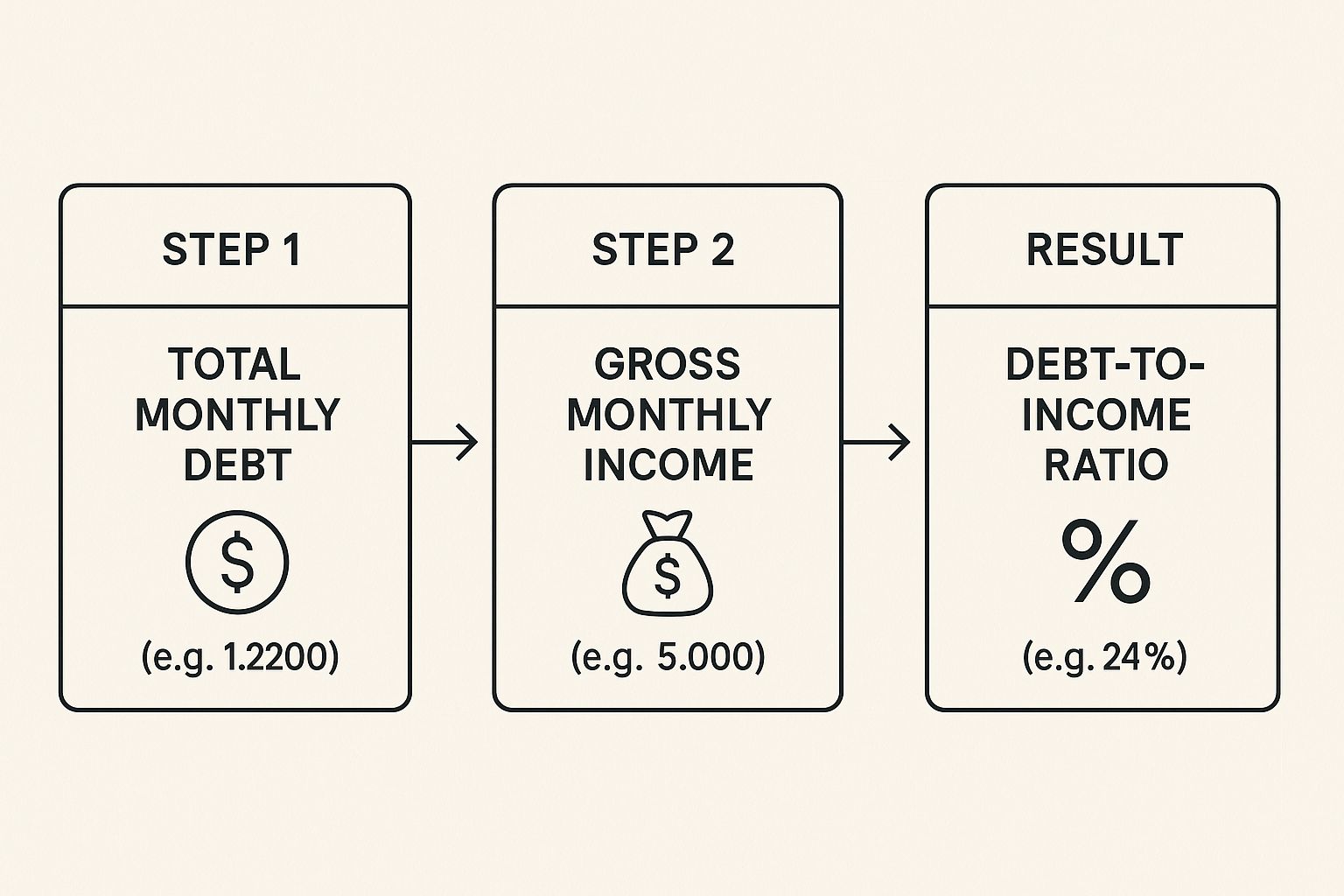
This simple math gives lenders a quick, clear snapshot of how comfortably you can manage a new mortgage payment on top of your existing debts.
Understanding Your Pre Approval Letter
If the underwriter gives you the green light, you'll receive your official pre-approval letter. This document is your golden ticket to serious house hunting, but it's crucial to understand what's actually in it.
Your pre-approval letter is a conditional commitment from the lender. It specifies the maximum loan amount, the loan type (e.g., Conventional, FHA), and an estimated interest rate, empowering you to make a confident offer on a home.
Make sure you pay close attention to a few key details:
- Maximum Loan Amount: This is the absolute ceiling for your home search. It's the highest price a lender is willing to finance for you, which helps you shop in the right price range from the get-go.
- Estimated Interest Rate: Your rate isn't locked in yet, but this gives you a solid estimate of what your monthly payments will look like.
- Expiration Date: Pre-approvals don’t last forever! They're typically valid for 60 to 90 days. If you haven't found a home by then, you'll need to provide updated financial documents to get it renewed.
With this letter in hand, you're not just a window shopper anymore. You're a serious, qualified buyer who is ready to compete in the housing market.
How to Overcome Common Pre Approval Hurdles
Hitting a roadblock during your mortgage pre-approval doesn't mean the dream is over. Think of it as a detour, not a dead end. Plenty of common hurdles pop up, but most are entirely fixable with a little strategy and patience.
Knowing what these challenges are ahead of time is half the battle. Whether it's a credit score that’s just a few points shy or a debt load that's a bit too heavy, these issues don't have to sink your homeownership plans. Let’s look at how to tackle them head-on.
Addressing a Low Credit Score
A credit score that doesn't quite meet the lender's minimum is a frequent stumbling block, but it’s also one of the most correctable. Lenders see this three-digit number as a reflection of your reliability, so putting in the work to improve it is a powerful move.
First things first: pull your credit report from all three major bureaus. Comb through them for errors—disputing an inaccuracy is often the fastest way to get a quick boost. From there, focus on the fundamentals: make every single payment on time and start chipping away at your credit card balances. Lowering your credit utilization ratio (how much credit you're using versus how much you have available) can make a huge difference, and fast.
Tackling a High Debt-to-Income Ratio
Your Debt-to-Income (DTI) ratio is one of the most critical numbers in your application. If it’s too high, lenders get nervous that you won't have enough breathing room in your budget for a new mortgage payment. The solution here is a two-pronged attack: decrease your debt or increase your income.
To get your DTI down effectively, focus on knocking out smaller loans first, like a personal loan or a car payment. Eliminating an entire monthly payment from your books has a much bigger impact on your ratio than just slightly lowering the balances on several larger loans.
On the other side of the equation, look for ways to boost your income. Maybe that's a side hustle or simply making sure you've documented all your bonuses and commissions that weren't included in your initial application.
Handling Unconventional Employment or Down Payments
Life isn't always a neat and tidy W-2. Plenty of people are self-employed, work on contract, or receive down payment help from family. Lenders are used to seeing these scenarios, but they demand meticulous documentation to get comfortable with them.
- For freelancers or the self-employed: You'll need to show a stable and predictable income stream. That usually means getting at least two years of tax returns, profit and loss statements, and business bank statements ready to go.
- For down payment gifts: If a relative is giving you money for your down payment, you can't just transfer the funds. You must provide a formal gift letter. This is a signed document stating that the money is a true gift—not a loan that needs to be repaid. For a lender, that distinction is everything.
Common Questions About Mortgage Pre-Approval
Jumping into the world of home loans can feel like learning a new language, and it's completely normal to have questions. Getting clear, straightforward answers is the best way to move forward with confidence. Let's tackle some of the most common things buyers ask about getting pre-approved.
Does Applying With Multiple Lenders Hurt My Credit Score?
This is a big one, and it's a valid concern. The answer isn't a simple yes or no. While every pre-approval application does trigger a hard inquiry on your credit report, the credit scoring models are smart enough to know what you're up to.
FICO and VantageScore, the two main credit scoring models, understand that you're shopping for the best deal. They treat multiple mortgage inquiries made within a short window—usually 14 to 45 days—as a single event. So, you can shop around for the best rate without damaging your score. The key is to get all your applications in within that tight timeframe.
What Should I Do If My Pre-Approval Expires?
A pre-approval letter isn't good forever; it typically lasts for 60 to 90 days. If you haven't found a house and gotten an offer accepted in that time, you’ll just need to get it renewed. Don't worry—this is a standard part of the process for many buyers.
You'll have to send your lender some updated documents, like your latest pay stubs and bank statements. As long as your financial situation hasn't changed significantly (for example, you haven't taken out a new car loan or lost your job), renewing your pre-approval is usually a quick and painless update.
Can I Get Pre-Approved If I Am Self-Employed?
Absolutely. It's a different path, and the paperwork is more intensive, but being self-employed won't prevent you from getting pre-approved. Instead of just handing over W-2s, you’ll need to paint a much more detailed picture of your business's financial health.
Lenders will want to see items such as:
- At least two years of your business and personal tax returns.
- A recent profit and loss (P&L) statement.
- The last few months of your business bank statements.
What they're looking for is a stable, predictable income stream over a significant period. It's all about proving your business is on solid ground.
A growing number of younger buyers, including entrepreneurs, are successfully navigating these requirements. Data from early 2025 shows that first-time homebuyers are a huge force in the market, with Generation Z buyers making up about 25% of all first-time homebuyer loans. You can learn more about these homebuyer trends at mortgagetech.ice.com.
What Happens If My Financial Situation Changes?
This is critical: you must tell your lender immediately if your financial situation changes after you've been pre-approved. That means any changes to your job, a drop in your income, or taking on new debt like a car loan or a big credit card purchase.
Trying to hide it will only cause problems later. Lenders perform a final credit check and re-verify your employment right before you close, so they will find out. Being upfront and proactive is always the best approach and gives you the best chance at keeping your loan on track.
Ready to make your move? The team at ACME REAL ESTATE FLORIDA knows this market inside and out. We'll help you navigate the pre-approval process and find a home you'll love. Let's get started at https://www.acmeflorida.com.
