
You’ve found the perfect home, your offer was accepted, and you’ve saved up for the down payment. But before you get the keys, there’s one last financial hurdle to clear: closing costs.
So, what are they, exactly? Think of them as the collection of fees you pay to finalize the purchase of your home. They’re separate from your down payment and typically run between 2% to 6% of the home's purchase price.
To put that in perspective, for a $400,000 home, you should plan on budgeting anywhere from $8,000 to $24,000 just for these final expenses. It’s a wide range, but knowing what to expect is half the battle.
Unpacking Your Final Home Buying Expenses
Closing costs are essentially the service and processing fees required to make your home purchase official. Just like you might have checkout fees for a large online order, buying a home involves a team of professionals—lenders, attorneys, appraisers, and more—who perform essential services to make the transaction legal, secure, and final.
For many home buyers, the final number can be a bit of a shock, but it helps to understand what you’re paying for. Every dollar is tied to a specific task that protects you, the seller, and the lender before those keys are officially yours.
What Services Do Closing Costs Cover?
So, where does all that money actually go? While the list of fees on your closing statement can seem long, they generally fall into a few key categories. Budgeting for them is a critical step, just as important as meeting all the other requirements to buy a home in Florida.
Your closing costs will typically cover:
- Lender Fees: These are the charges for creating and processing your loan. Think of things like the loan origination fee and the underwriting fee.
- Title and Legal Services: This is a significant category. You're paying to make sure the property has a "clean" title, meaning there are no ownership disputes or liens. This involves a detailed title search and the purchase of title insurance policies.
- Third-Party Verifications: Your lender needs to verify a few things, so you'll pay for essential reports like the home appraisal (to confirm its value) and a credit report check.
- Government Taxes and Fees: Local and state governments get their piece of the pie, too. These are fees for officially recording the new deed and mortgage, which legally transfers the property into your name.
The primary goal of closing costs is to facilitate a secure, legal, and financially sound transfer of property ownership. From verifying the home's value to ensuring a clean title, each fee plays a role in protecting your investment for years to come.
Closing Costs at a Glance
To give you a clearer picture, here’s a quick breakdown of what you might expect to pay in closing costs based on a few common home prices in Florida.
| Home Purchase Price | Estimated Closing Cost Range (2% – 6%) |
|---|---|
| $350,000 | $7,000 – $21,000 |
| $450,000 | $9,000 – $27,000 |
| $550,000 | $11,000 – $33,000 |
| $650,000 | $13,000 – $39,000 |
As you can see, the numbers can add up quickly. Planning ahead for these expenses is the best way to avoid any last-minute financial stress.
Estimating Your Total
That 2% to 6% range is a solid starting point, but your final bill will depend on several things—the home's location, the type of loan you get, and the specific services needed all play a part. In 2025, the national average still falls within that range. For a typical single-family home, this could mean paying anywhere from $6,800 to $18,000 or more.
Understanding the roles of the professionals involved, like the abstractors who dig through public records to conduct title searches, gives you a better sense of where your money is going. By planning for these costs from the very beginning, you can ensure a smooth journey to the closing table and, finally, to getting the keys to your new home.
Decoding Your Loan Estimate Line by Line
Receiving your Loan Estimate can feel like trying to read a foreign language. It's a dense, multi-page form packed with line items, numbers, and jargon that can make even the most prepared home buyer's head spin. But don't toss it aside—this document is your single best tool for understanding the real costs before you commit.
Think of the Loan Estimate as an itemized receipt you get before you pay. Its whole purpose is to give you a clear, standardized breakdown of every fee tied to your mortgage. This section will help you translate confusing terms into simple concepts so you can review your estimate with confidence.
Understanding Lender Fees
The first group of costs you'll spot are the fees paid directly to your mortgage lender for creating your loan. These are the charges for their services, much like a mechanic charges for labor in addition to parts. Getting pre-approved is a great first step, and understanding the mortgage pre-approval requirements can give you a head start on what lenders are looking for.
Common lender fees include:
- Loan Origination Fee: This is the lender's main charge for processing your loan application. Consider it their administrative fee for the paperwork, time, and effort that goes into creating your mortgage. It's usually calculated as a percentage of the loan, typically 0.5% to 1%.
- Underwriting Fee: Underwriting is essentially a deep financial background check. Your lender does this to verify that you can repay the loan. This fee covers the cost of having a professional underwriter comb through your credit, income, and assets to give the final approval.
- Application Fee: Some lenders charge this upfront just to apply. While it's less common today, it’s meant to cover the initial costs of handling your request.
Payments to Third-Party Services
Next up, you'll see a list of services from independent companies—not your lender. Your lender requires these services to ensure the property they're helping you buy is a sound investment. You're paying for a team of specialists to double-check every part of the deal.
Here are the most common third-party costs:
- Appraisal Fee: Before finalizing the loan, the lender needs proof that the house is worth what you're paying. This fee pays an independent, licensed appraiser to assess the property's market value. Think of it as getting an expert's official valuation to protect both you and the bank.
- Credit Report Fee: A small but unavoidable charge to pull your credit history and scores from the major bureaus. Lenders need this to assess your creditworthiness.
- Flood Certification: This fee pays a third party to determine if the property is in a federally designated flood zone. If it is, you’ll be required to get separate flood insurance.
This infographic shows how these individual costs fit into the three main buckets of your total closing expenses.
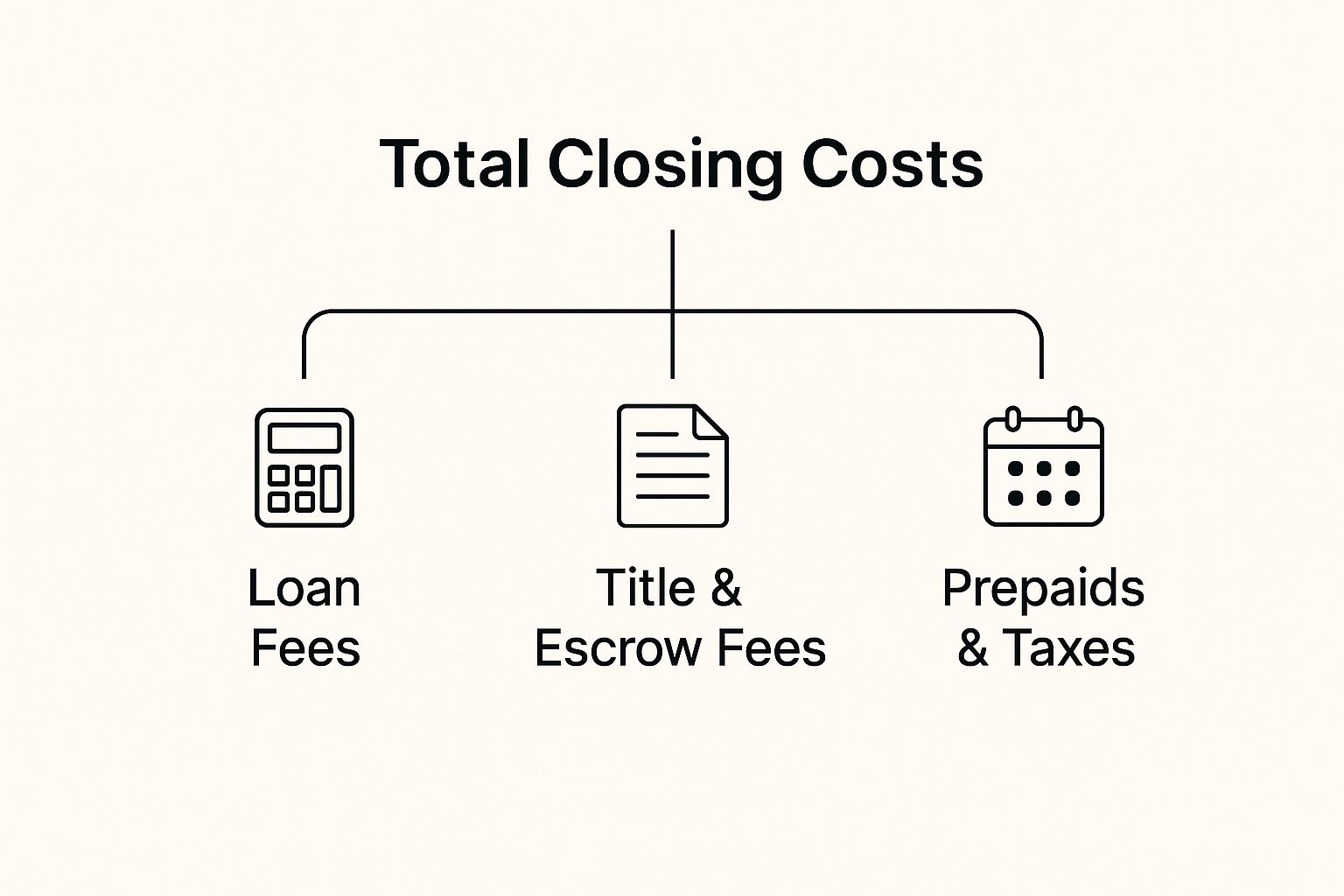
As you can see, loan-related fees are just one piece of the pie. Title services and prepaid expenses make up the other large portions of your final bill.
Breaking Down Title and Government Fees
The last major category of costs is all about legally transferring the property to you and making sure your ownership is protected. These fees go to title companies and government agencies to make the sale official and secure.
These aren't just administrative charges; they are crucial safeguards. Title services protect you from past ownership claims, while government recording fees make your ownership a matter of public record.
You can expect to see these on your Loan Estimate:
- Title Search: This is a deep dive into public records to ensure the seller has the legal right to sell the property. It uncovers any existing liens, ownership disputes, or other claims that could cause issues later.
- Lender's Title Insurance: This policy is required by the lender and protects them from any future title problems. It’s their insurance policy on the investment they are making.
- Owner's Title Insurance: This one is technically optional but highly recommended. This policy protects you, the new homeowner. It's a one-time fee paid at closing that defends your ownership rights for as long as you own the home.
- Recording Fees: These are charges from your county or local government to officially record the sale. This makes your purchase part of the public record, legally cementing you as the new owner.
Once you know what each line item means, you can confidently review your Loan Estimate, compare offers from different lenders, and help prevent surprises on closing day.
Understanding Prepaids And Escrow Accounts
Many homebuyers focus on the down payment and the closing costs we've already covered, but there's another piece to the puzzle: prepaids. These can sometimes be a surprise, but they're a crucial part of the final cash you'll need at the closing table.
Think of it this way: prepaids aren't fees for services you've already received. Instead, you're funding your home’s expense account for bills that are just around the corner, like your property taxes and homeowner's insurance. It’s about getting ahead of the curve to ensure you're covered from day one.
What Is An Escrow Account?
So, where does that prepaid money actually go? Your lender will set up a special savings vehicle called an escrow account, sometimes referred to as an impound account. This account is managed by the lender specifically to pay your property tax and homeowner’s insurance bills for you.
Each month, your mortgage payment will include an extra portion that gets deposited into this escrow account. Then, when those large yearly or semi-yearly bills come due, your lender pays them on your behalf using the funds you've built up. This system protects both you and the lender from ever missing a critical payment.
An escrow account is basically a financial shock absorber. It smooths out your budget by breaking down large annual bills into small, manageable monthly chunks, so you're never hit with a surprise five-figure tax bill.
To get this account up and running, your lender will require an initial deposit at closing. This upfront funding makes sure there's enough of a cushion in the account to handle the first round of bills when they arrive.
How Lenders Calculate Your Initial Deposit
Figuring out that initial escrow deposit involves a calculation that depends heavily on timing. The lender needs to collect enough to pay the upcoming tax and insurance bills, plus a mandatory reserve—usually a two-month cushion—to handle any unexpected increases.
Here’s what they base the calculation on:
- First Year's Homeowner's Insurance: You’ll almost always pay the entire first year's insurance premium at or before you close. This is a classic prepaid item.
- Property Taxes: The lender will estimate your annual property taxes and then calculate how many months' worth they need to collect upfront. This amount can vary dramatically depending on what time of year you close on your home.
It’s impossible to overstate just how important it is to understand why homeowners insurance is essential for protecting what is likely your biggest asset. It's a non-negotiable cost and a key part of your prepaids.
Getting a handle on the difference between standard closing costs and these prepaid expenses is vital for creating a truly accurate budget. It's like knowing what to expect during the due diligence period in Florida; the more you know upfront, the fewer surprises you'll face. By accounting for prepaids, you can walk into closing day with confidence, knowing exactly how much cash you really need.
How Your Location Changes Closing Costs
Think closing costs are a fixed, nationwide price tag? Think again. The state, county, and even the city you buy in can significantly alter your final total. Geography isn't just a small factor—it's one of the biggest drivers of what you'll owe at the closing table.
This happens because some of the largest fees are set by state and local governments. Things like real estate transfer taxes, recording fees, and local property tax rules are completely unique to each jurisdiction. What might cost a few hundred dollars in one state could easily run several thousand in another.
State and Local Taxes Make the Biggest Difference
The single biggest variable is often the real estate transfer tax, which you might also hear called a "documentary stamp tax." This is simply a tax the government charges to legally transfer the property from one person to another. Some states don't have one at all, while others have rates that can add a staggering amount to your bill.
It's a huge range. For example:
- States like Texas and Missouri have no state-level transfer tax, which can be a massive win for buyers there, often leading to lower overall costs.
- On the other hand, a state like Pennsylvania has a 1% state transfer tax, plus local governments can add their own on top. This can push the total to 2% or more. On a $400,000 home, that’s an extra $8,000 you wouldn't see in a no-tax state.
That massive swing is exactly why you can't just plug a national average into your budget and call it a day. Where you buy is an important piece of the puzzle.
A Closer Look at Florida and Orlando Closing Costs
Here in Florida, we have our own unique set of location-specific costs. The most important one for buyers to know is the Florida Documentary Stamp Tax on mortgages. This is a state tax you pay on the loan amount itself. The rate is $0.35 per $100 (or any fraction thereof) of your mortgage. So, for a $350,000 loan, this tax alone adds $1,225 to your closing costs.
You’ll also see a documentary stamp tax on the deed, which is based on the home's sale price. While sellers traditionally pay this in Florida, it's good to know it exists as part of the transaction's total cost. In most Florida counties, the rate is $0.70 per $100 of the price.
Getting a handle on these hyper-local fees is absolutely essential. They might look like small percentages, but they add up fast and can seriously change the amount of cash you need to bring to closing in a market like Orlando.
Understanding the National Landscape
While your local fees will cause the biggest swings, it’s still helpful to see the bigger picture. A recent analysis took a deep dive into mortgage closing costs across the U.S. and found that the national average was about $4,661, or roughly 1.06% of the sales price. This tells us that while taxes create major outliers, the core service fees from lenders and title companies are actually fairly consistent. You can discover more insights about these 2025 purchase mortgage closing costs to see how different regions stack up.
Knowing that the core fees are fairly stable is a big help. It means you can focus your energy on researching the variables that really matter in your target area: the local taxes and government recording fees. By understanding both the national baseline and your city’s specific costs, you’ll be in a much better position to build an accurate and reliable home-buying budget.
Actionable Strategies to Lower Your Closing Costs

Now that you understand what closing costs are, the next step is to actively work to reduce them. This is where you can make a real difference in your bottom line.
While some fees are non-negotiable, many can be lowered with smart planning. Think of your closing cost estimate less as a fixed price tag and more like the starting point for a conversation. With a few proactive moves, you can potentially save thousands of dollars—cash that could go toward your move, new furniture, or immediate home projects. The secret is to start early and know exactly where you have leverage.
Compare Lenders and Their Fees
When shopping for a mortgage, it's easy to focus only on the interest rate. But the fees lenders charge can vary wildly and will have a massive impact on your total closing costs. Don't just take the first offer that comes your way. Make it a rule to get at least three official Loan Estimates from different lenders.
Once you have them, lay them out side-by-side and go through them line by line. Pay special attention to these areas:
- Origination Fees: This is a big one. It's often a percentage of the loan, and some lenders might charge 1% while another charges 0.5% or even nothing at all.
- Underwriting and Application Fees: These administrative costs can differ by hundreds of dollars from one institution to the next.
- Points: Check if one lender is charging you points to get the same interest rate another is offering for free.
Never be afraid to ask a lender if they are willing to match a competitor's lower fees. The worst they can do is say no, but you might be pleasantly surprised by how flexible they can be to earn your business.
Negotiate for Seller Concessions
This is probably one of the most powerful tools in your toolbox. Seller concessions are an arrangement where the seller agrees to pay for a portion of your closing costs. The amount is credited directly to you at the closing table, which means you have to bring less cash out of your own pocket.
In a buyer's market, sellers are often more willing to offer concessions to make a deal happen. For conventional loans, sellers can typically contribute anywhere from 3% to 9% of the purchase price, depending on your down payment.
Even when the market is competitive, it never hurts to ask. A seller who is motivated to close quickly might agree to cover a specific cost, like the title insurance policy, just to keep the process moving forward.
Shop for Your Own Services
Your lender will likely give you a list of recommended providers for certain services, but you are not always obligated to use them. Your Loan Estimate will clearly state which services you are allowed to shop around for. Taking a little extra time here can lead to significant savings.
The most common "shoppable" service is title insurance. Make a few calls to different title companies and get quotes for both the title search and the insurance policies. You might also be able to shop for other services like the property survey or a pest inspection.
Be Smart About Your Closing Date
Here’s a simple but surprisingly effective trick: schedule your closing for the end of the month. One of the prepaid items you cover at closing is the daily interest on your loan for the remaining days of that month.
For example, if you close on the 5th of the month, you'll owe about 25 days of prepaid interest. But if you close on the 28th, you’ll only be responsible for a few days' worth. This simple calendar adjustment can easily save you several hundred dollars in upfront cash.
Understand No-Closing-Cost Mortgages
You’ve probably seen lenders advertise "no-closing-cost" mortgages. Those costs don't just vanish into thin air. The lender is covering them, but they get their money back in one of two ways:
- A Higher Interest Rate: You'll pay a slightly higher rate for the entire life of the loan.
- Rolling Costs In: The closing costs are added to your total loan balance, meaning you're borrowing more money.
This can be a decent option if you’re short on cash for closing, but you have to be aware of the long-term trade-off. You will ultimately pay more in interest over the years.
Thinking through these options can feel like a lot, but weighing the pros and cons is key to finding the right fit for your financial situation. Here’s a quick breakdown to help you compare.
Cost-Saving Strategy Comparison
| Strategy | Potential Savings | What to Consider |
|---|---|---|
| Lender Shopping | $500 – $2,000+ | Requires comparing multiple Loan Estimates line-by-line. Focus on origination, underwriting, and points. |
| Seller Concessions | 1% – 9% of Sale Price | Highly dependent on market conditions and seller motivation. |
| Shopping Services | $300 – $1,000 | Focus on title insurance and survey fees. Requires extra research and phone calls. |
| End-of-Month Closing | $100 – $800+ | Easy to implement but relies on scheduling flexibility from all parties. |
| No-Closing-Cost Loan | Saves all upfront cash | Leads to a higher monthly payment and significantly more interest paid over the life of the loan. |
Ultimately, a combination of these strategies often yields the best results. Start by shopping for the best lender, then see what you can negotiate with the seller. Every dollar you save at the closing table is a dollar that stays in your pocket.
Common Questions About Closing Costs
As you get closer to closing day, big-picture ideas about buying a home start to give way to smaller, more practical questions. You understand the concepts, but now it’s about the details—the timing, the final numbers, and all the little "what-ifs" that pop up.
Let's tackle some of the most common questions from home buyers so you can walk into your closing with confidence.
When Will I Know My Final Closing Cost Amount?
This is a huge one, and thankfully, the process is designed to avoid last-minute sticker shock. Your first real preview comes in the form of a Loan Estimate, a document you’ll get within three business days of submitting your mortgage application. Think of it as a detailed, good-faith breakdown of all the costs you can expect.
The final, definite numbers will arrive on your Closing Disclosure (CD). The law requires you to receive this document at least three business days before your scheduled closing. This isn't just a formality—it's your opportunity to review everything without pressure.
Pull out your original Loan Estimate and compare it to the Closing Disclosure, line by line. Some things, like prepaid interest, might change slightly depending on your exact closing date. But other fees are strictly regulated. Your lender's direct fees can't increase at all, and some third-party fees are only allowed to go up by a maximum of 10%. If you see a big jump you don't understand, that three-day window gives you plenty of time to call your lender and get it sorted out.
Can I Roll Closing Costs Into My Loan?
Sometimes, but it’s not always as simple as it sounds. "Rolling in" your closing costs just means adding them to your total loan amount. This lowers the amount of cash you need to bring to the closing table, which can be a huge help. It’s a common option for government-backed loans like FHA and VA loans.
With conventional loans, it’s a little trickier. Usually, the home has to appraise for more than the purchase price, which creates equity to absorb those extra costs. But there's a pretty big catch to this strategy.
When you roll costs into your mortgage, you're financing them for the life of the loan—that could be 30 years. It means you’ll be paying interest on those fees for decades, which can add a surprising amount to the total cost of your home over time.
You might also hear about "no-closing-cost" mortgages. This is a trade-off. The lender agrees to pay your closing costs for you, but in return, they charge you a higher interest rate on the loan. You save cash now, but you pay more every single month for years to come.
Are Closing Costs Different for New Construction?
Yes, they often are. Buying a brand-new home from a builder can come with a different set of closing costs you wouldn't see on a resale home. Builders often pass along some of the expenses tied to developing the property.
You might see some unique fees pop up, like:
- Builder’s Title Policy: Many builders have a preferred title company and may include this cost.
- Transfer Taxes: You'll likely be paying transfer taxes on the home's full, completed value.
- Utility Hookup Fees: The cost to get the new home connected to water, sewer, and the power grid can be passed along to you.
A common incentive builders offer is to pay a large portion of your closing costs, but it's almost always tied to you using their preferred lender. While convenient, you absolutely have to do your homework. Get a complete quote from the builder's lender—interest rate, fees, the whole package—and compare it with at least one or two outside lenders to make sure the "deal" you're getting is actually the best financial move overall.
Do I Pay Closing Costs If I Buy with Cash?
Even if you’re skipping the mortgage and buying with cash, you can’t escape closing costs entirely. The good news is your bill will be significantly smaller because you're taking the lender completely out of the picture. All those lender-related fees—origination, underwriting, application fees, the appraisal—vanish.
But you'll still need to pay for the essential services that legally transfer the property to you and protect your investment. A cash buyer should still plan on paying for:
- Title Search: This confirms the property has a "clean" title without any hidden claims or liens from previous owners.
- Owner's Title Insurance: This is a non-negotiable, one-time fee that protects your ownership rights for as long as you have the home. It's crucial.
- Settlement or Attorney Fees: You'll still need a professional to handle the legal paperwork and facilitate the actual closing.
- Government Recording Fees: This is the fee paid to the county to officially record the new deed in your name, making your ownership part of the public record.
These aren't optional extras; they're the fundamental costs of making sure you own your new home, free and clear.
Navigating the Orlando real estate market doesn't have to be complicated. If you're ready to find a home that fits your lifestyle, the team at ACME REAL ESTATE FLORIDA is here to make it happen. We know this city inside and out and are ready to help you make your move. Let's find you something amazing—check us out at https://www.acmeflorida.com.
