
The thought of buying a home with bad credit can feel defeating, but it’s a challenge many people successfully overcome. This guide is your realistic, actionable roadmap. We'll walk through the practical steps, from getting a real handle on your financial standing to finding lenders who actually specialize in your situation. A low credit score doesn't have to be a permanent roadblock to your homeownership dreams.
Your Path to Homeownership with Bad Credit
The dream of owning a home doesn't just vanish because your credit score has seen better days. While a lower score definitely presents some hurdles, it absolutely does not make buying a house impossible.
Here's something important to remember: Lenders look at more than just that three-digit number. They consider your income stability, how much you have for a down payment, and your overall financial habits. Knowing this is the first step toward building a winning strategy.
Think of this guide as your starting point. We're going to move past the myths and focus on what truly works. The journey involves a mix of financial discipline, smart planning, and really understanding the specific loan programs out there for you. It's less of a roadblock and more of a detour that just requires a bit more navigation.
What This Guide Will Cover
To turn your goal into a reality, you need a clear plan. We'll break down the entire process into manageable pieces, making sure you feel empowered, not overwhelmed.
Here’s a quick look at the core areas we’ll dive into:
- Understanding Your Credit: We'll show you how to look at your credit report through a lender's eyes to pinpoint exactly what needs your attention.
- Actionable Credit Improvement: You'll learn targeted tactics to boost your score, like how to strategically pay down debt and dispute errors that might be holding you back.
- Specialized Loan Programs: We'll uncover government-backed loans like FHA and VA, which are specifically designed with flexible credit requirements in mind.
- Securing Your Down Payment: Learn about down payment assistance programs that can dramatically reduce the amount of cash you need to bring to the table.
Setting Realistic Expectations
Let's be real: buying a home with a challenging credit history requires patience and persistence. It might take longer than it would for someone with a perfect score, and yes, you may face higher interest rates at first. But these are temporary conditions. The key is to get into a home first. You can always continue working on your financial health and refinance to a better rate down the road.
The most important thing to remember is that you have options. Lenders who specialize in mortgages for applicants with lower credit scores exist for a reason—there's a real need for them. Your job is to make your application as strong as possible in all the other areas.
To help you get a bird's-eye view, here's a quick summary of the main strategies we'll be discussing.
Quick Overview of Core Home Buying Strategies with Bad Credit
| Strategy Focus | What It Involves | Best For |
|---|---|---|
| Credit Repair | Disputing errors, paying down balances, building positive history. | Anyone with a score below 620 who can wait a few months to buy. |
| Government-Backed Loans | Applying for FHA, VA, or USDA loans with lower credit minimums. | First-time buyers, veterans, and those in rural areas with limited savings. |
| Down Payment Assistance | Finding state or local programs that offer grants or low-interest loans. | Buyers who have stable income but struggle to save a large lump sum. |
| Manual Underwriting | Finding lenders who will manually review your entire financial picture. | People with non-traditional income or thin credit files. |
Each of these paths offers a viable route to homeownership, and often, the best approach is a combination of a few.
Once you successfully navigate the home-buying maze, a whole new set of responsibilities begins. A great resource for this next chapter is this detailed new homeowner checklist, which outlines all the first steps to take after you finally get those keys. This is your chance to turn that dream into a tangible, achievable goal.
Understanding Your Credit Profile Like a Lender
Before you can even begin to map out a strategy for buying a home, you have to see exactly what lenders see when they pull up your financial history. Think of it like a coach studying game tape; you need to know your own stats, strengths, and weaknesses inside and out. Lenders use your credit profile to figure out how risky you are, and getting inside their heads is your first real step toward an approval.
This isn't just about knowing a three-digit number. It’s about digging into the why behind that score. Your mission here is to run a personal credit audit and pinpoint the exact red flags holding you back. That clarity is what will allow you to focus your energy where it'll make the biggest difference.
The whole process boils down to reviewing your credit reports, finding the negative marks, and understanding how your FICO score is calculated. This infographic breaks down the core steps.
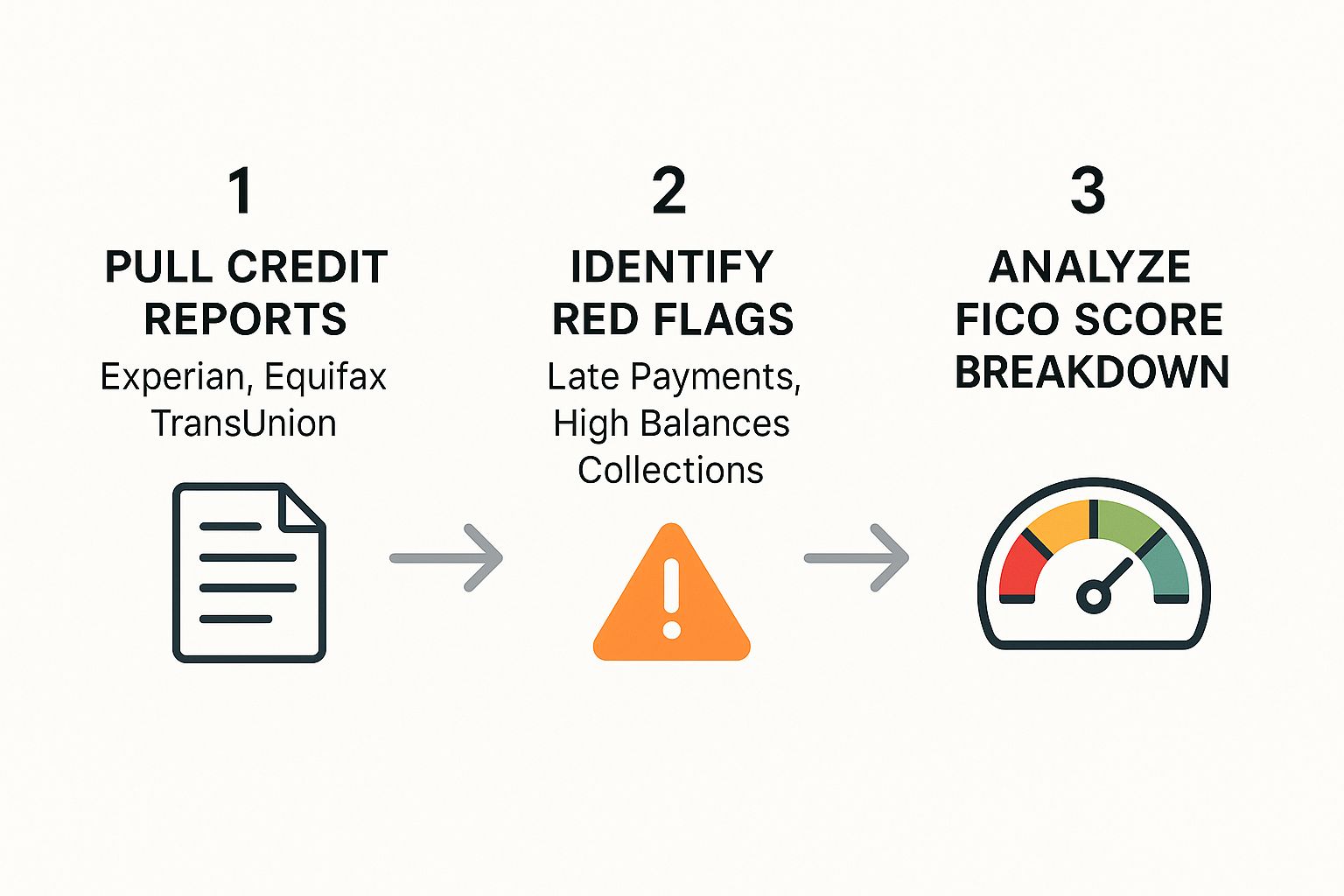
This visual guide simplifies that audit, showing how pulling your reports is the first step to identifying the problem areas dragging down your score.
Pulling Your Three Credit Reports
Your financial life is tracked by three major credit bureaus: Experian, Equifax, and TransUnion. When you apply for a mortgage, lenders almost always look at a "tri-merge" report that pulls data from all three. It’s critical that you do the same, because one report might have an error or old information that the others don't.
You are entitled to a free copy of your credit report from each bureau once a year through AnnualCreditReport.com, the only source authorized by federal law. The good news? Pulling these reports yourself is considered a "soft inquiry" and will not hurt your credit score. Once you have them in hand, you're ready to play detective.
What Lenders See as Red Flags
When a loan officer opens your file, certain things immediately jump off the page. These are the issues that scream "risk" and are almost certainly the culprits behind a low score.
Here are the most common red flags you need to hunt for on your own reports:
- Late Payments: This is the big one. Your payment history makes up a massive 35% of your credit score. Any payment that’s 30, 60, or 90 days late is a serious problem, and the later it is, the more damage it does.
- High Credit Utilization: This is simply the ratio of what you owe on your credit cards to your total credit limit. For example, if you have a card with a $5,000 limit and a $4,500 balance, your utilization is 90%. Lenders really want to see this number below 30%; anything higher suggests you might be stretched too thin.
- Accounts in Collections: A collections account means the original creditor gave up trying to get their money and sold your debt to a collection agency. This is a major blemish that tells lenders you didn't fulfill a financial agreement.
- Public Records: Things like bankruptcies, foreclosures, or tax liens are significant negative events that can stick to your report for seven to ten years.
Spotting these issues on your report is the crucial first move. For a more complete picture of the financial puzzle, our article on what are the requirements to buy a home provides more context on everything lenders evaluate.
It's also worth remembering that the wider economy plays a part. When there are signs of financial stress across the country, lenders naturally get more cautious. This can make them even more selective when reviewing applications from buyers with less-than-perfect credit.
The global credit scene also influences your ability to buy a house with bad credit. For instance, in the first quarter of this year, while most mortgages (97.6%) were current, delinquencies on other debts like personal loans and credit cards started to climb. This signals broader financial stress, pushing lenders to tighten their standards, especially for applicants they see as higher risk. You can dig into these global credit trends on the Equifax website.
Practical Ways to Boost Your Credit for a Mortgage
Let's be real: taking charge of your credit score is one of the most powerful moves you can make on the road to buying a home. It takes patience and a solid game plan, but the effort you put in today can be the very thing that gets you a mortgage approval tomorrow. This isn't about finding some magic trick; it’s about making smart, targeted changes that lenders will actually notice.
The mission is to show lenders that whatever happened in the past is just that—the past. When you demonstrate responsible financial habits now, you’re building a strong case for yourself as a reliable borrower who's ready for a mortgage. Think of it as your chance to rewrite your financial story.
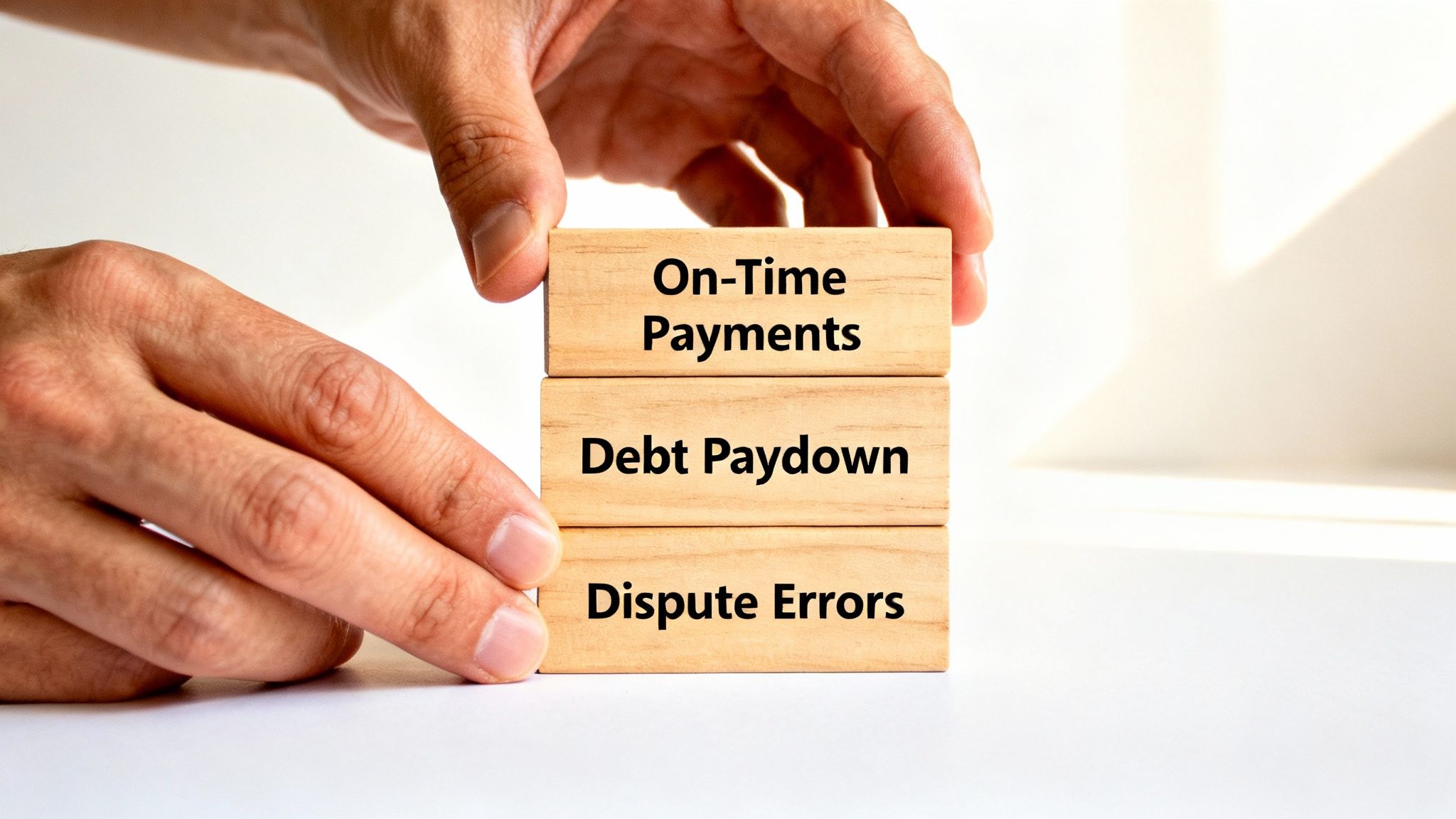
Tackle Your Credit Utilization Ratio First
If you’re looking for the fastest way to see a real jump in your credit score, look no further than your credit utilization ratio. This is simply the amount of credit you're using compared to your total credit limit, and it’s a big deal—it accounts for about 30% of your FICO score. When lenders see maxed-out cards, they get nervous. It signals that you might be stretched too thin financially.
Your target should be to get your balances below 30% of the credit limit on every single card. For instance, on a credit card with a $5,000 limit, you’d want to keep the balance under $1,500. Just focusing on this one thing can often give you a visible score boost in just a month or two.
Here are a couple of proven ways to get there:
- The Avalanche Method: Throw every extra dollar you have at the card with the highest interest rate first, while making minimum payments on everything else. This approach saves you the most money in the long run.
- The Snowball Method: Start by knocking out your smallest balance first, no matter the interest rate. This strategy gives you quick, motivating wins that make it easier to keep going.
Master the Art of Consistent, On-Time Payments
Nothing matters more to your credit score than your payment history. Nothing. It makes up a massive 35% of your score, and a solid track record of on-time payments is completely non-negotiable for any mortgage lender. Even a single late payment can derail your progress, so this has to be your top priority.
The easiest, most foolproof way to nail this is by setting up automatic payments for at least the minimum amount due on all your accounts. You’ll never miss a due date again. It’s a simple action that shows reliability and slowly but surely builds the positive history lenders need to see.
A lot of people think you have to carry a balance on your credit cards to build credit. That's a myth. You can pay your cards off in full every month, build a stellar payment history, and completely avoid paying a dime in interest.
Scrub Your Credit Reports for Errors
You would be shocked at how often inaccuracies on a credit report are the culprit unfairly dragging a score down. It could be a simple clerical error, an account that isn't even yours, or an old negative item that should have fallen off by now.
You have the right to dispute any mistakes you find directly with the three major credit bureaus—Experian, Equifax, and TransUnion. The process is pretty straightforward and can be done right on their websites. If they can't verify the item you're disputing, they are legally required to remove it. Poof—instant potential score boost.
Consider Credit-Building Tools
Is your credit history a little thin? Or maybe you just need to establish a more recent pattern of positive payments. If so, there are specific financial tools designed to help you build credit responsibly.
Helpful Credit-Building Options
| Tool Type | How It Works | Best For |
|---|---|---|
| Secured Credit Card | You put down a cash deposit that becomes your credit limit. You use it like a normal credit card, and your on-time payments get reported to the bureaus. | Anyone who has trouble getting approved for a traditional, unsecured credit card. |
| Credit-Builder Loan | A lender holds a small loan for you in a savings account. You make fixed payments over a few months, and once it's paid off, you get the money. | People who need to add a positive installment loan payment history to their credit report. |
Using these tools wisely is a clear signal to lenders that you're proactively working on your financial health. It shows you’re serious about getting mortgage-ready and are committed to managing your finances well.
Finding the Right Mortgage for Your Situation
A lower credit score definitely narrows your mortgage options, but it’s a myth that it eliminates them completely. You just have to shift your focus.
Forget conventional loans for a minute—their requirements are usually too strict. Instead, let's look at the specialized programs designed to create a path to homeownership for people with credit hurdles. Honestly, understanding these alternatives is the single most important step in buying a house with bad credit.
Your Best Bet: Government-Backed Loans
For most buyers working on their credit, government-backed mortgages are the most reliable way forward. These aren't loans from the government. They're loans from private lenders that are insured by a federal agency.
That insurance gives the lender a safety net, which makes them feel comfortable enough to offer more flexible terms to borrowers like you.
Three main programs stand out:
- FHA Loans: Backed by the Federal Housing Administration, these are wildly popular with first-time buyers and anyone with a lower score. Lenders can often approve an FHA loan with a credit score as low as 580 if you can bring a 3.5% down payment to the table.
- VA Loans: If you're a veteran, active-duty service member, or an eligible surviving spouse, a VA loan is an incredible benefit. The Department of Veterans Affairs doesn't set a minimum credit score (though most lenders look for something around 620). The biggest perks? Often zero down payment and no monthly mortgage insurance.
- USDA Loans: Offered by the U.S. Department of Agriculture, these loans are for homes in specific rural and some suburban areas. Like VA loans, they can offer 100% financing (no down payment!), but lenders typically require a minimum score of 640.
Getting ready to apply for one of these starts with knowing what lenders expect. It’s a good idea to review the typical mortgage pre-approval requirements so you can get your documents in order ahead of time.
An Alternative Route: Non-QM Loans
What if those government programs don't quite fit? There's another world of financing out there called Non-Qualified Mortgages (Non-QM).
These are loans that don't follow the standard, cookie-cutter rules set by government agencies. They can be a real lifeline for self-employed people with complex income streams or buyers who have a recent bankruptcy on their record.
But there's a trade-off. Because these loans are riskier for the lender, they almost always come with higher interest rates and require a much larger down payment—think 20% or more. They’re a niche solution, but sometimes they're the perfect fit when every other door has closed.
The reality is, lenders are more cautious now than they were a decade ago. We see it every day. Credit scores matter, a lot. This is precisely why specialized loan programs have become so essential for so many aspiring homeowners.
The data backs this up. For instance, the average credit score for a new FHA loan is now 38 points higher than it was back in 2008. Lenders have tightened their standards across the board. This trend makes it crystal clear why exploring government-backed options or alternative financing isn’t just a good idea—it’s a necessary strategy.
Coming Up With Your Down Payment and Closing Costs
When you’re trying to buy a house with less-than-perfect credit, a healthy down payment does more than just chip away at the loan amount. It’s a powerful signal to lenders. It shows you’re a serious, committed buyer and it directly lowers their risk. Honestly, this one factor can be the difference between getting a denial letter and getting the keys to your new home. But I get it—saving up can feel like climbing a mountain when money is already tight.
The trick is to stop hoping you’ll have money left over at the end of the month and start planning for it. You need a structured, intentional approach. Treat your down payment fund like a non-negotiable bill, just like your rent. That shift in mindset is where the real magic happens.

Building Your Savings Habit
The most painless way to save consistently is to put it on autopilot. Open up a dedicated, high-yield savings account that’s completely separate from your day-to-day checking. The "out of sight, out of mind" approach really works, keeping you from accidentally dipping into your house fund.
Next, schedule an automatic transfer to that account for every payday. Even if you start small, like $50 or $100 per paycheck, you’ll start building momentum. At first, forming the habit is way more important than the dollar amount.
Look Into Down Payment Assistance Programs
Saving on your own is just one piece of the puzzle. So many buyers have no idea there's a whole world of financial aid out there designed to help them over this exact hurdle. These are called Down Payment Assistance (DPA) programs, and they’re offered by state and local governments to make homeownership a reality for more people.
And here’s a pro tip: these programs are not just for first-time buyers! They can be a total game-changer if you're dealing with credit challenges. They usually come in a few different flavors:
- Grants: This is the best kind of money—the free kind you don't have to pay back.
- Forgivable Loans: Think of these as loans that disappear over time, as long as you live in the home for a certain period (say, five years).
- Low-Interest Loans: These are second mortgages with super low or even zero percent interest that you pay back alongside your main home loan.
The amount of help available is often surprising. We've put together a resource where you can dig into the options right here in the Sunshine State. Check out our complete guide to Florida down payment assistance programs to see what you might qualify for.
Don't just assume you won't qualify. Many DPA programs have pretty generous income limits and are specifically designed to work with government-backed mortgages like FHA loans, which already have more flexible credit requirements.
Right now, these programs are more important than ever. We're in an economic climate where mortgage delinquencies have ticked up from 0.92% to 1.03%. That kind of trend points to growing financial stress and can make lenders a bit more cautious. With big banks keeping their lending standards tight, borrowers with lower credit scores are under more scrutiny, making the boost from a DPA program absolutely critical. You can read more about what these delinquency trends on VantageScore.com might mean for the market.
How to Find and Apply for a DPA
Finding the right program takes a little digging, but the payoff can be thousands of dollars toward your home. Your state’s housing finance agency is the perfect place to start. For us in Florida, that’s the Florida Housing Finance Corporation (Florida Housing). Their website is the hub for all available state-level programs.
But don’t stop there. Many cities and counties offer their own localized assistance. A quick search for "[Your City/County] down payment assistance" can uncover some hidden gems. Your mortgage lender is also a fantastic resource here; they work with these programs all the time and can help you navigate the paperwork.
By combining your own savings with a DPA program, that daunting task of coming up with the cash for a down payment suddenly becomes much, much more achievable.
Common Questions About Buying a House with Bad Credit
Trying to buy a home when your credit has seen better days can feel like navigating a maze. It brings up a ton of questions, and getting straight answers is the only way to move forward without second-guessing every step. Let's tackle some of the biggest concerns I hear from aspiring homeowners in this exact situation.
What Is the Minimum Credit Score to Buy a House?
This is the big one, the question I get asked more than any other. The truth is, there's no single magic number. It all comes down to the type of loan you’re targeting.
For a lot of people, the most realistic starting point is an FHA loan. With this government-backed option, many lenders can work with scores as low as 580, provided you have a 3.5% down payment.
Now, FHA guidelines technically say you can get a loan with a score of 500 if you put 10% down. But in the real world? Finding a lender willing to take that risk is incredibly rare.
For other government-backed loans like VA and USDA, there isn't an official minimum score set by the government, but the lenders themselves usually draw the line somewhere around 620 to 640. And for a conventional loan, 620 is pretty much the absolute floor.
Your credit score isn't just a pass-or-fail test. Think of it more like a ladder. Every point you climb opens up more possibilities. A 615 might not get you a conventional loan, but getting it to 625 could—and that might save you a boatload of money over the years.
Each tier you climb—from the 500s to the 600s and beyond—unlocks better loan options and, crucially, lower interest rates. That’s why putting in the work to improve your credit before you even start looking at houses is one of the smartest moves you can make.
Will I Pay a Much Higher Interest Rate?
Let's be direct: yes, you probably will, at least at the beginning. Lenders see a lower credit score as a higher risk, and they price that risk into the interest rate. It's just the reality of the situation. A higher rate means a bigger monthly payment and more interest paid over the life of the loan.
But—and this is a big "but"—it's not a life sentence. A higher rate is often just the price of admission to get into your own home.
Once you’re in, you can focus on making every single payment on time, building equity, and polishing your credit profile. After a year or two of solid payment history, you can often refinance your mortgage into a much more favorable rate.
This is where shopping around becomes non-negotiable. Don't just go with the first lender that says yes. Get quotes from at least three to five different lenders. Some specialize in working with buyers who have credit challenges and might offer you a much better deal than a bank that doesn't.
Are There Specific Programs in Florida for Bad Credit Home Buyers?
Absolutely, and this is where a lot of Florida buyers catch the break they need. While you won't see programs advertised as being for "bad credit," the Florida Housing Finance Corporation (Florida Housing) has a toolbox full of resources that are a perfect match for buyers in this boat.
These state programs are designed to be paired with FHA, VA, or USDA loans—the very loans that already have more forgiving credit standards. The real magic, though, is the financial assistance they offer for your down payment and closing costs.
Here are a couple of standouts:
- The Florida Assist Loan Program: This gives you a deferred second mortgage of up to $10,000. It's a zero-interest loan, and you don't make any payments on it until you sell the house, refinance, or pay off your main mortgage.
- HFA Preferred Grants: These programs can offer grants—money you don't have to pay back—to cover a chunk of your down payment.
Getting help with the cash you need to close can be a complete game-changer. For the latest details and to see if you qualify, always check the official Florida Housing website.
How Can I Strengthen My Application Besides My Credit Score?
Your credit score is a huge part of the story, but it's not the whole story. Lenders are looking at your complete financial picture to gauge how reliable you are. You can make your application much stronger by beefing up a few other key areas.
First off, lenders want to see stability. A consistent two-year employment history, especially with the same company or in the same line of work, goes a long way.
Next, get your debt-to-income (DTI) ratio as low as you possibly can. This means paying down credit cards, car loans, or personal loans and not taking on any new debt while you're house hunting. A low DTI shows the lender you'll have plenty of breathing room in your budget for a mortgage payment.
Finally, if a specific event—a medical crisis, divorce, or layoff—is the reason for your credit troubles, tell that story. A clear, well-written letter of explanation gives the underwriter the context they need. It shows them that your past struggles were situational, not just a pattern of bad financial habits. That human touch can sometimes be the very thing that pushes an application from "maybe" to "approved."
Are you ready to stop scrolling through listings and start living your best Florida life? The team at ACME REAL ESTATE FLORIDA knows Orlando's market inside and out and can connect you with the right resources to make your homeownership dream a reality. Hit us up and let's find you something amazing. Learn more at https://www.acmeflorida.com.
