
Figuring out what your home is actually worth might seem complicated, but it's more straightforward than you think. You can get a quick ballpark figure using online Automated Valuation Models (AVMs), dive a bit deeper with your own Comparative Market Analysis (CMA), or call in a professional appraiser for the most accurate number.
Your Guide to Understanding Home Valuation
Whether you're thinking about selling, looking to refinance, or just want to keep tabs on your biggest investment, knowing your home's market value is essential. This isn't a static number; it shifts with local market trends, interest rates, and the condition of your property. Nailing this figure can be the difference between a quick, profitable sale and months of frustrating price drops.
It helps to think of your home's value as having a few different identities, each for a specific purpose:
- Market Value: This is the number that matters most—what a ready, willing, and able buyer would likely pay for your home in today's market. It’s the key figure for both buyers and sellers.
- Assessed Value: Your local government uses this value to calculate your property taxes. It's often lower than market value and isn't updated as frequently.
- Appraised Value: This is a formal valuation determined by a licensed professional after a detailed, in-person inspection. Lenders require this to approve a mortgage or refinance.
For most homeowners, the market value is the real prize. It's the number that will shape your pricing strategy and guide your financial planning.
Factors That Shape Your Home Value
A property's worth is a mix of things you can control and things you can't. The biggest one, without a doubt, is location. A home's value is fundamentally tied to its neighborhood, including proximity to schools, parks, and the general character of the area. Fair housing laws ensure that value is assessed based on objective property features and location benefits available to all, not on the demographics of the community.
Beyond where it's located, the physical characteristics of your house play a massive role. The key attributes that buyers notice are:
- Size and Layout: Square footage gives you a baseline, but the flow of the floor plan is what really sells a home. Open-concept living spaces and a logical room layout make a huge impact.
- Age and Condition: A well-maintained older home can easily hold its own against a new build, especially if big-ticket items like the roof, HVAC, and plumbing are in great shape.
- Upgrades and Features: Modern updates, especially in kitchens and bathrooms, almost always deliver a solid return on investment.
Many homeowners start with a quick online estimate, which is a great first step.

These tools use public data to give you an instant number, but remember to treat it as a starting point, not the final word.
Home Valuation Methods at a Glance
Trying to decide which method is right for you? This table breaks down the most common approaches to give you a quick overview of their speed, cost, and best use cases.
| Method | Best For | Typical Cost | Accuracy Level |
|---|---|---|---|
| Online AVMs | Quick, initial estimates | Free | Low to Medium |
| Agent CMA | Pricing a home for sale | Free (from a potential agent) | Medium to High |
| Professional Appraisal | Official valuations for loans | $400 – $700+ | High |
| FHFA HPI Calculator | Tracking market trends over time | Free | Low (for individual homes) |
Each method serves a different purpose, so the "best" one really depends on what you need the valuation for. An AVM is great for a gut check, but you'll need an appraisal for a bank loan.
Broader Economic Influences
Finally, remember that your home's value doesn't exist in a vacuum. It’s tied directly to the wider economy. Interest rates are a perfect example—lower rates boost buyer purchasing power and can push prices up, while higher rates tend to cool things down. Things like local job growth and the number of homes for sale also create the supply-and-demand dynamic that ultimately sets your property's current worth.
Once you have a handle on your home's value, the next critical step is making sure it's properly protected. The right coverage is non-negotiable, and this essential guide to homeowners insurance is a fantastic resource to help you sort through your options.
Using Online Estimators for a First Look
So, you're starting to wonder, "What's my house actually worth?" The quickest and easiest first stop is almost always online. Major real estate sites have free home value estimators that give you a ballpark figure in seconds. Think of these as a fantastic, no-commitment starting point to get a feel for your home's value.
These tools run on something called an Automated Valuation Model, or AVM. It’s a smart algorithm that crunches huge amounts of public data—tax records, recent sales in your area, property details—to spit out an estimate. It's like a high-speed, data-driven comparison engine.

The process couldn't be simpler: type in your address, hit enter, and you've got a number. This initial figure is based on the basics the AVM can easily find, like your square footage, bed and bath count, and the last time it sold.
Getting a More Accurate Online Estimate
That first number is useful, but it's often just a rough sketch. The real magic happens when you dive in and refine the details. Most of the big real estate portals let you "claim" your home's profile and feed the algorithm more accurate, up-to-date information.
To sharpen that estimate, you'll want to:
- Correct the Basics: Is the square footage right? Does it show four bedrooms when you only have three? Simple errors can throw the whole number off, so make sure the core facts are accurate.
- Add Your Renovations: This is a big one. Did you just remodel the kitchen or finally finish that basement? The AVM doesn't know about that unless you tell it. These are high-value updates that public records won't show.
- Update Key Features: Don't forget to mention things like a brand-new roof, a new HVAC system, or those energy-efficient windows you installed last year. These are major selling points that add real value.
By feeding it this extra context, you’re helping the AVM move beyond a generic area comparison and create a valuation that’s much more specific to your home.
Key Takeaway: Treat online estimators as a directional guide, not gospel. Their accuracy can vary—some reports show a median error rate of 2-7%, but it can be much higher for unique homes or in fast-moving markets. It's just one piece of the puzzle.
Understanding the Limitations of AVMs
It's absolutely critical to remember what these online tools can't do. An algorithm has never set foot inside your house. It has no idea about the incredible morning light in your kitchen, the pristine condition of your original hardwood floors, or that stunning view from the back deck.
Here are the biggest blind spots for any AVM:
- Home Condition: It can't see minor deferred maintenance, like a leaky faucet, nor can it appreciate high-end finishes or the fact that you’ve meticulously cared for the place.
- Neighborhood Nuances: An AVM probably won't distinguish between your quiet cul-de-sac location and an identical house two blocks over on a busy main road.
- Market Subtleties: It can lag behind hyper-local trends. If your specific block suddenly becomes the hottest spot in town, the AVM might be the last to know until the sales data catches up.
At the end of the day, these estimators are a fantastic first step. They give you a free, instant baseline that helps frame your expectations. Just be sure to treat that number as a conversation starter, not the final word.
Performing Your Own Market Analysis
Ready to roll up your sleeves and dig into the data? While those online estimators are a decent starting point, doing your own Comparative Market Analysis (or CMA) gives you a much sharper, more customized picture of your home's actual worth.
The whole process boils down to finding and analyzing "comps"—industry slang for recently sold properties that are genuinely similar to yours. And this isn't just about grabbing the sale price of the house down the street. A true comp needs to be a close cousin to your property across several key data points. Getting this right is the absolute foundation of an accurate valuation.
Identifying Strong Comparable Sales
Your mission is to find at least three to five properties that a potential buyer for your home would have also seriously considered. You're looking for your home’s closest relatives in the current market.
Here’s the checklist for what makes a powerful comp:
- Recency: The market can change quickly. Focus on homes sold within the last 3-6 months. A sale from a year ago might as well be from a different economic era.
- Proximity: Stick to your immediate neighborhood, ideally within a half-mile radius. Avoid crossing major barriers like a highway or a different school district line, as these create distinct micro-markets.
- Size: Look for homes with similar square footage. A good rule of thumb is to stay within a 10-15% range of your own home's size. A 1,500 sq. ft. ranch is not a good comp for a 3,000 sq. ft. two-story.
- Features: Match the fundamentals, especially the number of bedrooms and bathrooms. A three-bed, two-bath home needs to be compared to other three-bed, two-bath homes.
This part of the process requires you to look past the listing photos and get down to the hard data. This quick visualization breaks down how location-based data comes together.
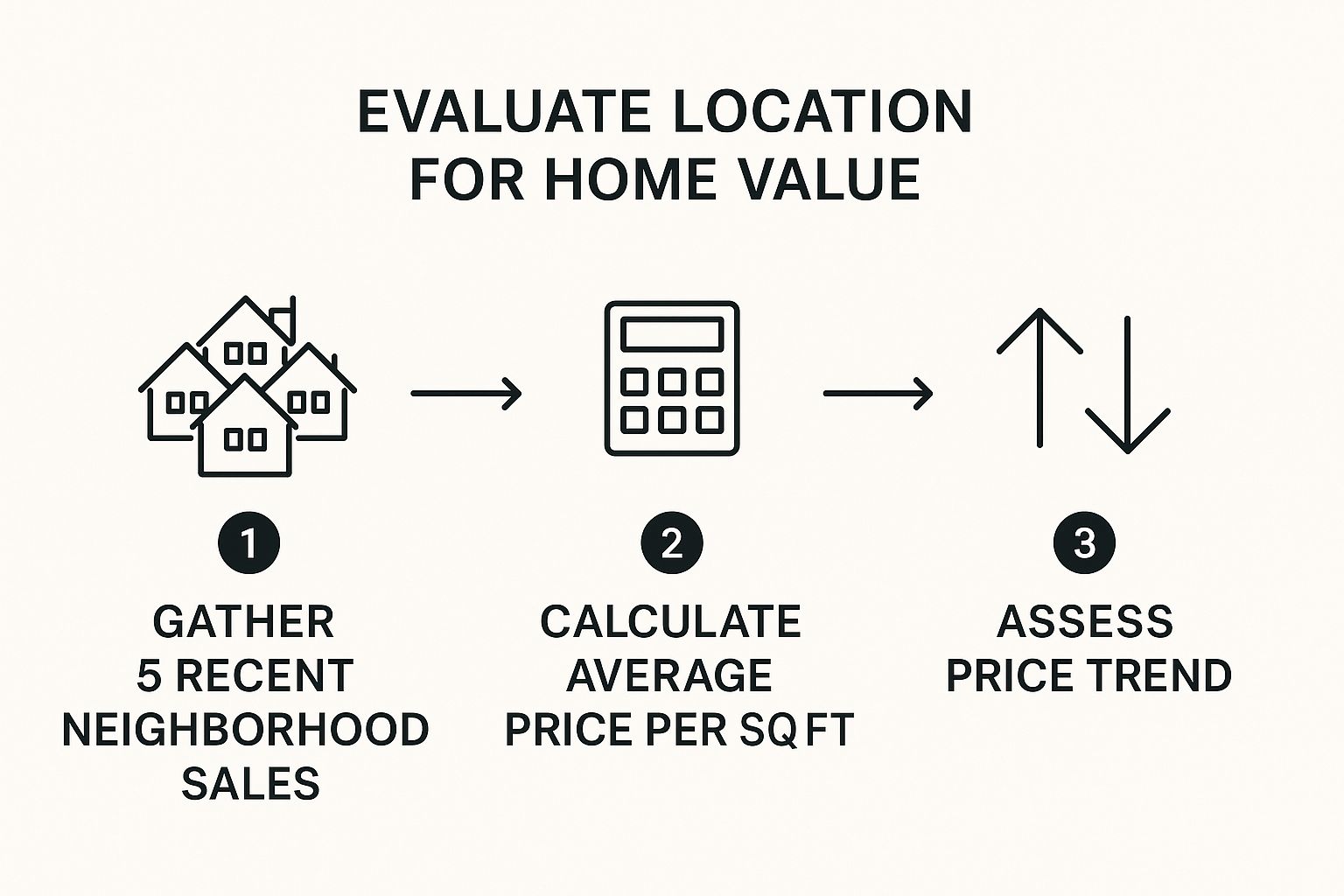
As the infographic shows, pulling recent sales helps you nail down a baseline price per square foot. It also reveals whether your area values are trending up, down, or holding steady.
Making Smart Adjustments
Here’s the thing: you’ll almost never find a perfect, carbon-copy comp. This is where the real analysis comes in. You have to logically adjust for the differences between your property and the ones you’re comparing it to.
Let's say your home has a stunning, brand-new kitchen, but your best comp has a dated one. You can’t just compare the sale prices straight up. You need to add value to the comp's sale price to equalize it with your home's superior feature.
Here are a few common adjustments you'll almost certainly need to make:
- Condition and Upgrades: If a comp has a beautifully renovated primary bathroom and yours is original, you'll subtract the approximate value of that upgrade from its sale price to make it comparable.
- Key Features: Does your home have a swimming pool, a finished basement, or a two-car garage while a comp doesn't? Each of these adds value that you have to account for.
- Lot Size and Location: A comp on a premium corner lot or with a great view will naturally sell for more than an identical house on a standard interior lot. You'll need to adjust for that premium.
Pro Tip: Don’t just pull adjustment values out of thin air. Look for patterns in your market. For instance, if homes with pools consistently sell for $30,000 more than similar homes without them in your area, that's a solid, data-backed number you can use.
The heart of this method is solid data. Historical sales information is the cornerstone for determining a home's value, especially when using this sales comparison approach. Professionals are constantly adjusting values based on differences like size, location, age, and renovations, using rich data from public records to find multiple comps for accuracy. You can see just how critical historical data is in professional appraisals with these insights from Pacific Appraisers.
Calculating Your Estimated Value
Once you've picked your comps and made all your adjustments, the last step is doing the math to find your home's estimated market value.
Let’s walk through a quick scenario. Imagine your home is 2,000 sq. ft. You find three solid comps that sold nearby:
- Comp A: Sold for $400,000. It's nearly identical, but it has a screened-in patio your home lacks (a feature worth about $10,000 in your market). Your adjusted price for this comp is $390,000.
- Comp B: Sold for $425,000. It's a bit larger and has a new roof, but your kitchen is far superior. After you subtract for its advantages and add for yours, its adjusted value might come down to around $410,000.
- Comp C: Sold for $395,000. This one is in slightly rougher condition, needing about $15,000 in updates to match your home. So, its adjusted price is $410,000.
After adjusting, your comps give you a very tight value range of $390,000 to $410,000. This evidence-based range is far more reliable than any single online estimate and gives you a powerful tool for understanding how to determine home value with real confidence.
Navigating the Professional Appraisal Process
When the stakes get serious—like when you’re trying to secure a mortgage, refinance, or settle an estate—those online estimates and your own research just won’t cut it. You need a rock-solid, legally recognized valuation.
This is where a professional, state-licensed appraiser comes in. They provide the most accurate and defensible opinion of your home’s value, and it’s a critical part of most major real estate deals.
Unlike an online tool that’s just crunching public data, an appraiser provides a comprehensive, in-person evaluation. Their entire job is to deliver an unbiased, thoroughly researched assessment of what your home would likely sell for on the open market. Lenders depend on this number to make sure the property is solid collateral for the loan they’re about to issue.

This process is way more than a quick walkthrough. The appraiser is a trained professional who meticulously documents everything about your property that impacts its worth.
What Appraisers Look for During the Inspection
Think of the on-site visit as a fact-finding mission. The appraiser isn’t there to critique your design choices; they’re gathering hard data about your home’s physical traits and condition. They’ll methodically measure the exterior to confirm the gross living area and check out its structural integrity.
Inside, their attention is on the tangible features that add to the bottom line. Here’s what’s on their checklist:
- Overall Condition: They’ll note the quality of the construction and how well the home has been maintained. Any signs of deferred maintenance, like a worn-out roof or peeling paint, will be documented.
- Room Count and Layout: They confirm the number of bedrooms and bathrooms and evaluate how functional the floor plan is.
- Upgrades and Finishes: Have you updated the kitchen or bathrooms recently? New flooring? Modern light fixtures? They’ll note all of it, as these things can seriously boost value.
- Major Systems: The age and condition of your HVAC, plumbing, and electrical systems are all taken into account.
- Unique Features: Extras like fireplaces, a great deck, a swimming pool, or a fantastic view all get factored into the valuation.
The appraiser then takes all this on-site data and combines it with a deep-dive analysis of market trends and recent comparable sales—similar to a CMA, but with a much higher standard of verification and adherence to professional standards.
Understanding the Appraisal Report
Once the inspection is done, the appraiser puts all their findings into a detailed report. For most homes, this will be the Uniform Residential Appraisal Report (URAR). It’s a standardized form that gives the lender a complete picture of the property and a clear explanation of how the appraiser arrived at their final number.
A professional appraisal is the gold standard for determining a home's value. It’s a powerful combination of verifiable data and an expert’s on-the-ground analysis. The final report has to follow strict federal guidelines, which ensures you’re getting an impartial and well-supported valuation.
The URAR is no small document. It includes photos of your home, a detailed sketch of the floor plan, and an in-depth analysis of the neighborhood. Most importantly, it features at least three recent comparable sales. The appraiser carefully adjusts the value of each "comp" to account for any differences between it and your property, which ultimately leads to a reconciled final value.
How to Prepare for the Appraiser's Visit
While you can’t change an appraiser’s professional opinion, you can definitely help them do their job well by making sure they have all the information they need. A little prep work can make the whole process smoother and avoid any confusion about your home’s best features.
Here are a few practical tips to get you ready:
- Compile a List of Upgrades: Type up a simple document listing all the major improvements you’ve made. Include the completion date and a rough cost for each. This is huge for work that isn't immediately obvious, like a new roof or HVAC system.
- Ensure Full Access: The appraiser needs to get into every room and space. Make sure they can easily access all areas of your home, including the attic, basement, and any sheds or garages. Clearing clutter that might block their path or get in the way of measurements is always a good idea.
- Handle Minor Repairs: Take care of any small issues like a leaky faucet, a broken light switch, or a door that doesn't close properly. These minor fixes won't drastically swing the value, but they contribute to the overall impression of a well-cared-for home.
Getting ready for an appraiser is a lot like prepping for a buyer's showing. For more tips on putting your home’s best foot forward, you can learn more about how to prepare for a home inspection, since many of the same ideas apply. At the end of the day, presenting a clean, accessible, and well-documented property helps the appraiser see its true value.
Look Beyond Your Four Walls: Market Trends and Public Data
Your home’s value isn’t just about the granite countertops or the fresh coat of paint. It’s deeply tied to the world right outside your front door. Comps and individual features are a huge piece of the puzzle, but they don't tell the whole story. To really get a handle on what your home is worth, you need to zoom out and look at the bigger economic picture shaping your local real estate market.
This wider view gives you crucial context. Is your neighborhood buzzing, with buyers competing for a limited number of homes? Or are things a bit more relaxed, with properties lingering on the market and prices cooling off? Understanding these forces is the key to interpreting all the other data—like your comps—with much greater accuracy.
Tapping into High-Level Economic Indicators
A few powerhouse resources can give you a bird's-eye view of the housing market's momentum. One of the most respected is the Federal Housing Finance Agency (FHFA) House Price Index (HPI). This isn't your average online calculator; it's a serious economic measure that tracks single-family home price shifts across the entire country.
The HPI is so reliable because of its sophisticated method. It analyzes the prices of the same homes over time as they are sold or refinanced, using a massive dataset that goes all the way back to 1975. This approach filters out any quality differences, giving you a pure look at how prices are appreciating (or not) in a specific area. You can dive into the data yourself on the FHFA's official HPI data page.
With the FHFA’s tools, you can quickly see if home values in your city have been climbing, dipping, or staying flat over the last quarter, year, or even decade. It's the kind of intel that helps you understand if your investment is riding a wave in a hot market or facing headwinds from a broader slowdown.
What Your Property Tax Assessment Really Means
Another piece of the puzzle you already have is your local property tax assessment. Every homeowner gets this valuation from their county assessor's office—it's the number the government uses to figure out your annual property tax bill.
Finding this number is usually as simple as a quick search on your county appraiser’s website. But here's the catch: it's vital to understand what this number is and, more importantly, what it isn't.
Key Insight: Your tax-assessed value is almost never the same as your home's current market value. Assessors often use mass appraisal techniques and might only reassess every few years, meaning the figure can be wildly outdated and completely out of sync with what a buyer would actually pay for your home today.
Your tax assessment is a historical data point, not a current price tag. It’s a good reference to have, but don’t make the mistake of using it to price your home for sale.
How Local Trends Drive Your Home's Worth
Beyond the big national indexes and tax records, it’s the hyper-local, on-the-ground trends that really move the needle on a daily basis. These are the factors creating demand right in your own neighborhood.
Keep your finger on the pulse by watching these key local drivers:
- Inventory Levels: Look for the "months of supply" in your area. Anything under three months usually signals a hot seller's market, where fierce competition is likely to push prices up.
- Days on Market (DOM): This is the average time it takes for a home to go under contract. A dropping DOM means the market is heating up and buyers are making decisions fast.
- Local Development: Are new businesses, parks, or schools popping up nearby? These kinds of projects can dramatically increase an area's appeal and boost property values over time.
For a deeper dive into what's happening right here in our backyard, check out the latest Florida real estate market trends. Marrying that broad national data with specific local knowledge is how you get the complete, 360-degree view of your home's true value.
Common Questions About Home Valuation
Even after you've clicked through a dozen online estimators and sifted through neighborhood sales data, it's totally normal to still have a few lingering questions. Getting a handle on your home's value isn't always straightforward. Let's tackle some of the most common questions we hear from homeowners to give you that last bit of clarity.
With these answers, you'll be better equipped to move forward, whether you're planning to sell, refinance, or just keep an eye on your biggest investment.
How Much Do Renovations Impact Home Value?
Not all home improvements are created equal, especially when it comes to your return on investment. It's a common misconception that every dollar you spend on an upgrade comes right back to you at closing.
A sleek, modern kitchen or a beautifully updated bathroom almost always adds significant value and catches a buyer's eye. But other, more personal projects? Maybe not so much. That high-end swimming pool or elaborate custom landscaping might be your dream come true, but it might not recoup its full cost. The value really hinges on what buyers in your specific neighborhood expect and are willing to pay for. It’s all about striking a balance between what you'll enjoy and what the market demands.
Why Is My Tax Assessment So Different From Market Value?
This one trips up a lot of people. You get your property tax bill and see an assessed value that’s thousands—sometimes tens of thousands—of dollars different from what online tools or a Realtor are telling you. What gives?
The short answer is that these two numbers are calculated for completely different reasons. Your tax assessment is just a number your local government uses to figure out your property tax bill. It's often based on mass appraisal formulas or sales data that could be a year or two old. Since they aren't updated in real time, they almost never reflect the current housing market.
A professional appraisal or a well-researched Comparative Market Analysis (CMA) provides a much more accurate picture of what a buyer would likely pay for your home today.
How Often Does My Home's Value Change?
Think of your home's value less like a fixed price tag and more like a stock price—it’s always in motion. It can shift with every little change in mortgage interest rates, every new house that pops up for sale down the street, and every ripple in the wider economy.
While you'll probably only notice big swings over several months or a year, the underlying value is technically changing daily. Because of this, it's smart to re-evaluate your home's worth every one to two years, or anytime you're about to make a big financial move like selling or tapping into your equity. This ensures you're working with the freshest information possible.
Tracking these shifts isn't a new concept. Researchers have been compiling long-term data for decades, creating detailed housing price indexes for major cities that sometimes span over a century. If you're a data nerd, you can explore a major project on historical housing price data from the National Bureau of Economic Research to see how these trends are tracked. And when you're thinking about selling, knowing your home's value isn't just about setting the right price—it's also about preparing for things like the home sale capital gains tax.
At the end of the day, a home's value is a dynamic number, shaped by your property's unique charm and the powerful forces of the market. Staying informed on both fronts gives you a serious advantage.
At ACME REAL ESTATE FLORIDA, we combine deep market knowledge with a fresh approach to help you understand your home's true worth. If you're ready to make your next move in Orlando, let our crew guide you through the process with insider expertise. Stop guessing and start planning—let's find you something amazing.
